Thursday, February 19, 2026

Review: Called to Serve, Gifted to Lead: A Biblical and Practical Case for Women in Ministry by Dawn Gentry (Cloverdale, IN: Dialoge Press, 2026).

In Acts 18, we are introduced to Priscilla, the wife of Aquila and an early missionary. We do not know much about Priscilla or her and Aquila’s ministry, other than they served alongside Paul in Corinth and “explained the Way of God…more accurately” to Apollos (18:26, NRSV). What we do know, however, was that Priscilla was clearly called to serve and gifted to lead in ministry. When I think of modern-day Priscillas, Dawn Gentry is one name that comes to mind. I have had the pleasure of knowing Dawn for a number of years and drawing deeply from her tremendous experience and passionate faith. Her story is the story of many who have been called by God to serve yet found the door shut to them for various reasons. Yet, the conversation provided is not one of dissension or derision, but one of embodied engagement.

As I “sat down” with Dawn (at a table over a cup of tea, no less), two words kept rolling around in my mind—and they were not “egalitarian” or “complementarian” (although they were definitely discussed). One word was perspective, or, perhaps, worldview. In many ways, this book is not so much advocacy for equality of women in ministry as much as it is a discussion on embodied hermeneutics, the process through which we develop our doctrinal positions that become our theological perspective or worldview. This book drinks deeply from the sweet water well of scripture, encouraging the reader to prepare for each chapter by reading the relevant scripture before exploring that chapter. This conversation places itself under the authority of scripture, yet is not beholden to archaic traditions but rather embraces a redemptive tone that seeks to restore the created order as God intended it.

This leads to the second word—risk. Engaging in this work is risk. Opening oneself up to the possibility of change is risk. Embracing God’s plan and committing to following the Spirit is risk. Accepting a new perspective is risk, which is also what this book is about. Something that I deeply appreciate about Dawn is that she is not pushy. As she notes, her focus is not on “women’s rights” but on how men and women can serve together as they have been gifted by God (p. 33). This is a risk because it means opening up spaces once dominated by men for all who have been called by God to serve and have been gifted to lead. Yet, to be the church that God intends, it is absolutely a risk worth taking.


Monday, February 26, 2024

 Take Time to Rest

Sometimes, a nap just happens. I would be lying if I said that I had never fallen asleep at my desk. My desk is arranged in such a way that my chair is aligned parallel with a wall. And there have been times when, for some completely unexplained reason, my head nestles against the wall and I drift off to sleep, dreaming, I am sure, of another meeting. Ah, meetings.

But more to the point, my wife and I took our kids on a Disney cruise a few years ago. We got checked in and moved in relatively quickly, enough time that we could change into our swim gear (which, for me, is shorts and a t-shirt) and head up to the pool deck. I found a deck chair in the shade and told my wife that I was going to catch a quick nap before getting some reading in.

Now, I know that it had not been more than a few minutes later when my wife woke me up with a smile on her face to my perturbed frown. "Your snoring is cute, however we need to get ready for dinner." Confused, I asked how long I had been asleep. "About three hours. Guess you needed a nap."

Rest is a theological discipline that is as old as the creation story. In Genesis 2:2-3, we are told that God rested from the work of creation after creating humanity and placing them in the garden. This allowed God time to enjoy the good that God had created, to share rest in the moment. This call to rest from work and enjoy the presence of God is later reflected in Exodus 20 when God calls Israel to rest once a week through worship and communal celebration (20:8-11). They are to reflect the need for rest that God took and to do so through worship to God with one another.

We also see Jesus taking time to rest. In Mark 4, Jesus asked his disciples to sail across the Sea of Galilee so that they could rest after a long day of teaching. While Jesus was asleep in the boat, a storm arose that Jesus quickly silenced so that he could go back to resting (4:35-41). Later, in Mark 6, after his ministry in a Gentile region and the death of John the Baptizer, he asks his disciples to come with him a quiet place so that they could rest and grieve (6:30-32). It was also not uncommon for Jesus to go away for the evening and spend the night in prayer (Mark 6:45-46).

If the incarnate Christ required time to rest, reflect, and recharge, why do we think we can constantly run at full throttle? I am asking this question of myself as much as anyone. When I meet with students for mentoring, I often encourage them to take time to rest and practice solitude. Find a quiet place and dedicate five minutes to God, telling God that you are consecrating that time to be in God's presence. No noise, no distractions, nothing. Just you and God for a few moments. If you fall asleep, consider it a holy nap. As we emerge from the cold of winter into the hustle and bustle of spring, take time to rest.

"For God alone my soul waits in silence, for my hope is from him. He alone is my rock and my salvation, my fortress; I shall not be shaken. On God rests my deliverance and my honor; my mighty rock, my refuge is in God. Trust in him at all times, O people; pour out your heart before him; God is a refuge for us." -- Psalm 62:5-8 (NRSVUE)

Monday, October 7, 2019

Psalm 121: "My Help Comes from the LORD"

This psalm is part of the collection known as the “Songs of Ascent,” a collection (120-134) contained in Book 5 which parallels Deuteronomy in the Pentateuch or the “return from exile” in Israelite history.  The “Songs of Ascent” were traditionally used in what are known as the pilgrimage festivals (Passover, Shavuot and Sukkot) and were often sung as the congregation approached the Temple in Jerusalem.

This particular “Song of Ascent” is known also as a “Song of Trust,” a psalm that declares trust in God.  This trust, which is a relational component, has been formed through the peaks and valley of life, those times of disorientation and re-orientation that chart their way through the Psalms.  This psalm opens with a call-and-response structure.  The opening verse (v. 1) is the question posed by the poet and the liturgist.  Springing up from a lifetime of memories, the poet asks the congregation if they ascent to his question, hoping they hold trust in the same God that he does.  Thus, the natural expression is that “My help comes from YHWH!”

The remaining verses of this “Song of Trust” proclaims three elements of God’s nature that have served as the foundation for that trust.  In these verses, the poet notes that he trusts God’s direction.  The imagery in the first line (v. 3a) is that of God “keeping” the steps of the worshipper, much like a parent who helps a toddler take steps by clasping their hands around the child’s ankles and helping her learn the motion of walking.  The imagery of the remaining three lines (v. 3b-4) is that of God carrying the worshipper while the worshipper slumbers, much like the tales of mythical beasts carrying their wards in their arms or on their backs.

In v. 5-6, the poet notes that he trusts God’s provision.  In the New Revised Standard Version, the phrase “keeps” is repeated in each elemental passage.  Whereas the previous passage focused on God “keeping” the poet’s feet on the correct path, this passage focuses on God “keeping” the poet provided for.  Generally we think of provision as dealing with food or drink, however the tale of Jonah seems to hint in the background here as the poet trusts God to provide shade in the heat and shelter during the night (cf., Jonah 4:6).

In v. 7-8, the poet notes that he trusts God’s protection.  Here we see a more intimate nature of God’s “keeping.”  Drawing from more pastoral imagery, God is the worshipper’s shepherd, laying down in the gateway of the sheep pen, “keeping” the sheep in and “keeping” the thief out.  It is this imagery that inspired Jesus’ “I am the gate” teaching in John 10:7-10.  God does not simply nurse the wounds of the worshipper; God risks God’s own life to “keep” the worshipper safe.  In concluding his words here, the poet articulates that God is worth our trust because God directs, provides and protects us.

Articulating trust in God is easy when times are good and plentiful, yet harder when times are difficult and lean.  This psalm provides a structure for prayer in times when our trust in God is low, when our guilt rises and our faith wanes.  Begin by asking yourself the call of the opening verse: “From where does my help come?”  If you can honestly state that your help comes from God, remind yourself of why you trust God by thanking God for God’s direction, provision and protection.

Wednesday, February 20, 2019

Writing is...

Writing is one of those processes that, I think, just about everyone thinks they can accomplish.  I mean, you go to any bookstore and see all those glorious books on display?  "Surely, I can do that," you may think to yourself.

Or, thanks to the Internet, almost anyone with a computer can post an essay within a matter of minutes.  (Wait a minute...)  There are, depending on who you ask, over 150 million active blogs readily available for your reading.  (Compare this to over 28 million podcasts, whose numbers are growing at exponential rates.)  There are, literally, blogs or websites about everything.

Yet, what does it mean to be a writer?  And, more deeply, how does one go about writing?  These are fundamental questions, questions that I had not asked myself when I first began writing.  However, after nearly a decade of writing essays, articles, book chapters and a book, here is some advice that I have learned that I hope will encourage or challenge you in your writing.

  1. Writing is a craft that must be nurtured.  One of the things about writing is that is an activity that must be worked at.  Even someone who might be "gifted" at writing cannot survive on talent alone.  I have a book project on the Gospel of Mark that I have been working on for over fifteen years.  I am not sure if it will ever see the light of day.  It, like many other pieces, has become a workshop piece that challenges we as a writer.  In another case, one of my first articles was a simple page piece that sought to share a teaching tactic.  It was abysmal.  Looking back now, as I did the other day, I am both ashamed that I submitted the piece for publication yet also grateful that that particular journal gave me a second chance at publication.
  2. Just because I can, does not mean that I should.  Most writers are creative types.  Most creative types are almost always coming up with ideas.  Inspiration hits without warning.  This can be great for the writing process, or it can send us down the rabbit hole into distraction.  Some time ago, I pitched an idea an idea about theological themes in dystopian literature to my friend David Congdon (@dwcongdon), an editor with the University Press of Kansas.  His advice was quite simple: While the idea had merit, did I have the credentials to write it.  He was correct.  I love dystopian literature, however I am not a literature guy.  To date, I have submitted four book proposals that, I assume, have been rejected.  As difficult as it is to accept, there is wisdom in "staying in your lane."
  3. What about what works (and what does not and why).  I once proposed an article to a journal on mediating divorces in the congregational setting.  I had written the paper for a graduate class and had received a good grade.  I submitted the paper...and it was rejected.  It was rejected for one reason -- I didn't have any evidence that it would work.  I had never implemented it.  When writing, especially when writing practically, write out of your actual experience.  As I started on my dissertation, I discovered that I was regularly using my developing theory in my preaching.  I just had not named how the process worked yet.  In other articles, I have talked about things that worked and things that have not.  In doing so, it shows that a writer has credibility to speak about this issue.  And in today's marketplace, credibility is everything.
I hope this advice helps you as your develop as a writer.  It is a frustrating yet rewarding craft, one that advances thought and action with simple words and passionate minds.


Tuesday, February 12, 2019

Book Review: "The Witness of Preaching" (3rd edition) by Thomas G. Long

Thomas G. Long, The Witness of Preaching, 3rd ed. (Louisville: Westminster John Knox Press, 2016).  280 pp.  $35.00.

[Caution...that 4/5 is a bit misleading.]

To be honest, this is a book in which I agree with about 90% of the content. I have an infinite amount of respect for Tom Long, and reference him repeatedly in my multiple preaching classes. His passion for preaching and depth of wisdom has advanced the study and practice of homiletics in many ways.

That being said, and for as high of a rating that I gave this third edition (which really is the best edition, given the updating on issues like technology, plagiarism and the preacher's spiritual life), I ultimately do not accept Long's concept of "witness" as the paradigm for understanding the preacher's task.

I think to ignore the other paradigms that he discusses (and then dismisses) -- herald, storyteller and pastor -- seriously limits our ability to preach the gospel in a post-Christian society. Yes, this sounds counter-intuitive, given the theological nature of "witness." 

The issue, I have long thought, is two-fold: 

  1. Preaching must be about more than what we have simply "seen and heard" but also point towards transformation, a concept that Long finds deeply problematic to his Reformed approach to the Christian faith.
  2. Preaching must, therefore, employ various models and methods in order to effectively preach the gospel in a distracted culture. Heralds (prophets, John the Baptizer), storytellers (Qoheleth, the Gospel writers, Jesus) and pastors (Paul, Peter, Jude) have long advanced the gospel through a variety of communicative forms. Why, then, should contemporary preachers do any less?
If only witness was promoted as a "best practice" among a variety of best practices, much like Robert Stephen Reid's "four voices." Then, to me, this would be the homiletics textbook that we both need and deserve.

Note: This review was not solicited.  It was originally posted on my Goodreads page.

Monday, April 23, 2018

Star Trek Films, Ranked from Best to Worst

Yes, I am a Trekkie.  Not quite one that has an accurate cosplay outfit stuffed away in his closet, however that it not to say that I did not build a TNG bridge set in my parents' basement and act out my own stories when I was kid. 

I made what I could out of cardboard, construction paper and markers (i.e., communicator badge, pips, bridge stations) and saved up to buy what I couldn't make (a phaser and tricorder).  I developed my own series and wrote a handful of scripts, improvising other adventures.  Yes, dear tweeps, I was a Star Trek nerd.

Yet, as with the population's general enjoyment of Star Trek, my love of Star Trek waned once I graduated from high school.  I wanted to continue my love affair with the Enterprise and her crew, however the films following First Contact did not help.  Additionally, I never could get into Deep Space Nine (I mean Star Trek is about exploring space...you cannot do that when you are stuck on a space station) or Voyager.  By the time Enterprise came along, I had hidden my love for boldly going where no one had gone before deep within my soul.

Then came the rebooted films from J. J. Abrams.  Old feelings of warmth and enjoyment sprung to the surface of my typically logical soul.  I even began to wonder if my parents had kept any of my old Trek artifacts in their garage.  I went to see this new incarnation of Captain Kirk and company ... and was pleasantly surprised.  I liked what I saw.  Was it spot-on?  No.  Were there (significant) problems?  Absolutely.  Was it better than fan-fiction?  Yes.  And, in the words of ScreenJunkies, "Star Trek is cool again!" 

How the new voyages of the new Starship Enterprise are not the only reason why I am once again finding my joy in Star Trek.  Last year, I reviewed The Gospel According to Star Trek: The Original Crew by Kevin C. Neece.  The first fully faith-based discussion of Gene Roddenberry's sci-fi series brought me humbly before Netfilx to go back and re-watch the entire original series, animated series and original series films.  Now I am proudly and comfortably back in my universe, working through The Next Generation (I am almost finished with Season 7 as of this writing).

So, without any further plot exposition, I offer another ranking: the best and worst of the Star Trek films:

  1. Star Trek II: The Wrath of Khan (1982) -- This has it all.  Action, suspense, a genuinely creative sci-fi plot device (the Genesis device) and a compelling villain in Khan (Ricardo Montalban).  Add to this Nicholas Meyer's direction, James Horner's scoring and that scene in Engineering, and you have a film that captures all that Star Trek is meant to be.
  2. Star Trek: First Contact (1996) -- If Q was the great thorn in Captain Picard's side, then the Borg were his one great enemy.  The Borg had spent years ravaging the universe, including the Federation.  In this fun, thrilling time-travel piece, the Enterprise-D crew must prevent the Borg from stopping the first human warp-speed experiment.  In every way, it is made just as well as Star Trek II, which is my only reason for placing it second on this list.
  3. Star Trek VI: The Undiscovered Country (1991) -- In many ways, this film is a espionage thriller set in space.  Although the original cast is starting to show their age, there is still plenty to be excited about.  From the battle sequences to the "who dunnit" detective story, this is not redemption from the abysmal Star Trek V, but also serves as a great send off the Captain Kirk and his crew.
  4. Star Trek IV: The Voyage Home (1986) -- With Spock in tow, the crew begins making their way home only to discover that Earth is on the brink of destruction when a giant alien Hostess cake shows up and begins playing havoc with our weather patterns.  Back to the past they go again to find ... whales.  Yes, "There be whales here!"  This part is hokey, however watching the crew adapt to the twentieth-century is lighthearted and fun.  In many ways, this film is more akin to the original series than any of the other films.
  5. Star Trek: Generations (1994) -- With the series over, producers rushed to get the TNG crew on the big screen.  As a result, this film feels more like an unproduced two-part arc than a feature film.  However it has some good elements -- the production value is certainly ramped up, Malcolm McDowell's villain is one of the better Trek villains.  The highlight here is the scene between Kirk and Picard, where Kirk has one last adventure and Picard finally learns what it means to be "captain of the Enterprise."
  6. Star Trek III: The Search for Spock (1985) -- Who is the central character of the Original Series?  Some will say it was Kirk, some will say that it was a great ensemble.  I say that Spock was the central character, and has remained so throughout all incarnations of Star Trek.  We see it here.  Kirk and company put everything on the line to rescue Spock from the Genesis planet, reuniting old friends.  Unfortunately, Christopher Lloyd's turn as Klingon villain is wasted on an otherwise incomplete story.
  7. Star Trek V: The Final Frontier (1989) -- Okay.  Pretty much from here on, I am simply listing the films.  This film had two things going for it: 1) it proved the original crew needed one mroe outing, and 2) it gave us Kirk giving a soliloquy on why he was a starship captain.  However it also gave us this awful line: "What does God need with a starship?"
  8. Star Trek: The Motion Picture (1979) -- Riding high off of the success of Star Wars, the Enterprise launches onto the big screen to prove that sci-fi could be a big-budget product for flagship studios.  However, this movie is more Kubric than Spielberg, which makes it really difficult to watch...let alone enjoy.  Still, it is visually compelling and has a deep-theme plot.  Too bad it takes so long to get anywhere.
  9. Star Trek: Nemesis (2002) -- There are only two reasons why this film is "better" than Insurrection: 1) Tom Hardy's breakthrough performance as a genetically-engineered Romulan clone of Picard is worth watching, 2) Data becomes human by making the ultimate sacrifice, and 3) it's not Insurrection.
  10. Star Trek: Insurrection (1998) -- Although Sir Patrick Stewart thought this film offered a more accurate portrayal of Captain Picard's character, especially following the final engagement with the haunting Borg (we see Picard's moral center on full display here), and it is just as visually appealing at First Contact (kudos to Jonathan Frakes in this way on both films), this installment is generally considered to be muddled, slow and lacking the ethical depth presented in other TNG episodes that served as inspiration for this film.
You will note that I have not added the Kelvin timeline films to this list.  My reason is simple: the films directed/produced by Abrams are from a new timeline and do not play into the progression of events portrayed in the Original Series, the Next Generation and its "spin-offs" (of which I am not including Discovery).  I enjoy these films, however I think they must stand apart from the canon.  If, however, you are interested in hearing my thoughts, let me know. 

Thursday, December 28, 2017

Book Review: "Five-Word Prayers" by Lisa Whittle

Lisa Whittle, 5-Word Prayers: Where to Start When You Don’t Know What to Say to God (Eugene, OR: Harvest House Publishers, 2017), 164 pp.  $13.99.

Prayer is a mysterious thing, and how God works through prayer is even more mysterious.  Several years ago, I was working in a ministry organization that really made me question my calling in ministry.  I loved the work and (most of) those I worked with.  However my supervisor was anything but a Christian leader.  Her morals were questionable, her work ethic was sketchy and her treatment of her employees was determined by how little she paid you (the more you were paid, the worst you were treated, which included public shaming).  I was a hospital chaplain, and had just come out of a great situation.  I loved where I had worked, however my contract was up and I needed to move on.  So I moved across town and immediately regretted my decision. 

Fast forward about four months to an incredibly draining weekend where I ended by day by being chewed out for ministering to the family of a dying patient.  It was not my unit, however I was the only chaplain available that weekend.  The problem was not that I was on a unit that I was not assigned to (necessarily).  The problem had been that I had agreed to go and minister to them.  By the time I got home, my family was already in bed. Oh, did I forget that I had to be back at 8:00 am the next day.  I collapsed into my recliner and simply prayer, “God, please do something now.”  It was five words, yet it was probably the most heart-felt prayer that I had ever personally prayed.  Five words.

The next day…I was fired.  I am still to this day not sure that “you’re the best floor chaplain that I have” is sufficient reason for firing someone.  But like I said, everything about this lady was highly questionable.  After being let go, I went back to my office to finish my paperwork (it was the deal to get my last paycheck).  I flipped open my phone (yup) and saw that I had a voicemail.  It was the hospital that I had previously worked for, and they were offering me a job!  “Please come to a meeting tonight to hear more details.”  Less than twenty-four hours later, and it seemed that God has answered my prayer.  I would go on to spend 2-1/2 years with that hospital, leaving only to accept my current full-time teaching position.  Five words.

Please do not misunderstand me.  I am not saying that simply praying a simple prayer will solve all of your problems.  What I am saying is that our prayers, especially in difficult times, can be simple prayers—even as simple as five words.  This is the beauty of Whittle’s little book.  It is theologically light, and can border on advocating the very approach to prayer that I am cautioning you against in this review.  However, her “five-word prayers” are practical.  Some of her prayers can be adjusted for more critical moments of life, such as the sudden, tragic death of a loved one (“Please give me strength now” or “I want to trust you.”).  Yet, in for the busy, connected world that we live in, this prayer guide might be just what you need to find guidance from and fulfillment in God.

Monday, December 25, 2017

Books I Read in 2017

I have used Goodreads' feature for the last couple of years to share what I have read in a year.  However, I cannot distinguish specifically what types of books that I have read.  So, here is what I have read categorically in 2017.  I hope you find some inspiration here!

- Fiction

  • **Margaret Atwood, The Handmaid's Tale
  • *Philip Dick, Do Androids Dream of Electric Sheep?
  • Philip Dick, The Man in the High Castle
  • T.S. Eliot, The Wasteland and Other Writings
  • James Hannah, The A to Z of You and Me
  • *Madeline L'Engle, A Wrinkle in Time
  • John LeCarre, Our Kind of Traitor
  • Dennis Lehane, Live by Night
  • Cormac McCarthy, Child of God
  • *Cormac McCarthy, No Country for Old Men
  • Arthur Miller, Broken Glass
  • **George Orwell, 1984
  • Philip Roth, The Plot Against America
  • William Shakespeare, Macbeth
  • *William Shakespeare, Much Ado About Nothing
  • William Shakespeare, Romeo and Juliet
  • Jeff Vandermeer, Annihilation
- Biblical Studies

  • *David Bartlett, Romans
  • *Dave Bland, Proverbs, Ecclesiastes, and Song of Solomon
  • *Charles Cousar, Reading Galatians, Philippians and 1 Thessalonians
  • **Peter Enns, The Bible Told Me So
  • Beverly Gaventa, First and Second Thessalonians
  • Robert Jewett, The Thessalonian Correspondence 
  • Derek Kidner, The Message of Ecclesiastes
  • Thomas Mann, Deuteronomy
  • Bonnie Thurston, Reading Ephesians, Colossians and 2 Thessalonians
  • N.T. Wright, Galatians and Thessalonians
  • N.T. Wright, Romans, Part One: Romans 1-8
  • N.T. Wright, Romans, Part Two: Romans 9-16
- Education

  • *Lorrie Blair, Writing a Graduate Thesis or Dissertation
  • Leisyte and Wilkesmann, Organizing Academic Work in Higher Education
  • *Stabile and Ershler, Constructivism Revisited in the Age of Social Media
  • *Ernest Stringer, Action Research
  • Marshall Welch, Engaging Higher Education
- Ministry


  • *Herring and Elton, Leading Congregations and Nonprofits in a Connected World
  • Ron Susek, Firestorm
  • **Thomas Tumblin, AdMinistry
- Preaching/Communication


  • *Jeffrey Arthurs, Preaching with Variety
  • Decker and York, Speaking with Bold Assurance
  • Gonzalez and Jimenez, Pulpito
  • *Hogan and Reid, Connecting with the Congregation
  • Eunjoo Mary Kim, Preaching the Presence of God
  • *Marshall McLuhan, Understanding Media
  • Lane Sebring, Preaching Killer Sermons
  • Frank A. Thomas, They Like To Never Quit Praisin' God
- Psychology/Leadership

  • *Brene Brown, Daring Greatly
  • *Angela Duckworth, Grit
  • **Viktor Frankl, Man's Search for Meaning
  • *Paulo Freire, Pedagogy of the Oppressed
  • Sebastian Junger, Tribe
- Theology (Systematic, Spiritual)

  • *Bland and Webb, Creation, Character, and Wisdom
  • *Dietrich Bonhoeffer, Creation and Fall/Temptation
  • **David Congdon, The God Who Saves
  • *Zach Hoag, The Light is Winning
  • Kyle Idleman, Grace is Greater
  • *Kelly Kapic, Embodied Hope
  • *C.S. Lewis, A Grief Observed
  • *Kevin C. Neese, The Gospel According to Star Trek
  • John Walton, The Lost World of Adam and Eve
  • Lisa Whittle, 5-Word Prayers
  • *Brian Zahnd, Sinners in the Hands of a Loving God
- Miscellaneous

  • Harriot Castor, Starting Chess
  • *Richard Rothstein, The Color of Law
The books marked with an (*) are the ones that I enjoyed a little more, and the ones marked with an (**) were my favorites from 2017.  What did you read?  Did you read any that I did?  What recommendations do you have?  Leave your comments below or connect with me on Twitter.  And happy reading in 2018!

Saturday, March 4, 2017

Book Review: "Grace Is Greater" by Kyle Idleman


Kyle Idleman.  Grace is Greater: God’s Plan to Overcome Your Past, Redeem Your Plan, and Rewrite Your Story.  Grand Rapids, MI: Baker, 2017.  188 pp.  $15.99.

Grace is a major conversation topic within Christianity.  The front matter of this book alone attests to that: Of the 13 advanced praise statements, 11 are from author who have a book with the word “grace” in the title.  It, honestly, leads one to question why we need another book on grace.  The answer, equally simply enough, is that the doctrine of grace is multi-faceted.  It is wide-ranging and requires a multiplicity of voices to help us understand it.  And, as you will quickly learn through his stories, Idleman is one who is learning what grace is all about.

Following an introductory chapter, the book is divided into three sections.  Each section focuses on a particular area of concern, an area that Idleman argues that “grace is greater” than: mistakes, hurt and circumstances.  The first unit focuses on the mistakes that can separate us from experiencing God’s restorative grace (guilt, brokenness, and regrets).  For me, the chapter that really stood out in this section was the chapter on regret (chapter 3).  In this chapter, Idleman explores the difference between regret and shame, with regret being defined as “feeling bad about something you have or haven’t done” (p. 51) and shame being defined as “feeling bad about who you are or how you think you’re being perceived by God or others” (p. 52).

The second unit focuses on the hurts that can prevent us from experiencing God’s healing grace (wounds, bitterness, vengeance and resentment).  For me, the chapter that really stood out in this section was the chapter on vengeance (chapter 6).  It was a refreshing chapter because of Idleman’s opening words: “If you’re in ministry, some people won’t like you.  At all” (p. 103).  As one who has been burned in ministry before, Idleman’s focus on releasing my rights to hold on to that pain was very enlightening.  Ministers are often quick to speak about grace, yet we move slower than most when it comes to extending it.

The third unit focuses on the circumstances that can derail us from experiencing God’s guiding grace (disappointments, weakness and despair).  For me, the chapter that really stood out in this section was the chapter on weakness (chapter 9).  In a culture that has tried to “Christianize” suffering by adopting cliché mantras like “just pray about it” or “God has a plan for your suffering,” Idleman addresses how these trite views actually devalue the powerfully redemptive grace that God offers us through Christ and the daily indwelling of the Spirit. 

Overall, I really liked this book from Kyle Idleman.  It was thoughtful, humorous, decently researched (often a shortcoming of “Christian living” books) and practical.  In addition to the lack of solid research, “Christian living” books are often impractical.  What I mean is that they sound really good, yet they fail in actually providing instruction on how to integrate their concepts into the life of the reader.  While his book is not as practical as books by, say, Arron Chambers or John Ortberg, Idleman does try to give some ways of integrating his concept of accepting God’s grace.  For example, in the chapter on weakness (chapter 9), he asks the reader to state a weakness.  Then he offers two reflective questions to help the reader process why this is a weakness and how to find strength to overcome the weakness.  Finally, he walks the reader through the process of accepting grace and integrating this into the reader’s life.


Finally, this book would make an excellent discussion topic for a small group or book club study, a recommended read for a “new Christians” class, or even as a guide for a preaching series.  Idleman’s easy-to-listen-to style makes for a quick read and can easily be accommodated for the preacher who is looking for a practical way to speak about such a central doctrine of our religion.

Monday, February 6, 2017

Book Review: "Preaching Killer Sermons" by Lane Sebring

Lane Sebring, Preaching Killer Sermons: How to Create and Deliver Messages that Captivate and Inspire (Centreville, VA: Preaching Donkey, 2016), 191 pp. $12.48.

I took my first official preaching course in the Fall 1999 semester.  In that course, I was introduced to a text that laid the foundation for my communicative practice in preaching, tips and tricks that I still use today.  A decade later, when I taught my first introductory preaching course, I used that same book, Preaching that Connects by Mark Galli and Craig Larson (both, then, journalists with Christianity Today).  Their material was simple, basic, almost common-sense.  It was pulled from a combined decades of journalism, writing stories with punch that related to the everyday reader.  Although not necessarily preachers themselves, they wrote a book that, in my opinion, every preacher must read.  It is not a theory book; it is a mechanics book, yet one that will absolutely help your development.

You see, when it comes to preaching, to the art of crafting sermons, it comes down to 3 “Ds”: design, development and delivery.  Design has to do with the scaffolding or main structure that the preacher chooses to build the sermon on.  The design is the “bones” of the sermon.  Whether it is inductive (moving from general to specific), deductive (moving from specific to general), narrative (following a plot) or some other syllogistic form, all sermons, when deconstructed down to their base parts look exactly the same.  It’s basic rhetorical design, something that has been with us since Aristotle.

Now, development deals with the “stuff” that goes into our weekly sermons: textual commentary, illustrations, points of doctrine, and practical applications.  This is the blood, muscles and tissue of the sermon.  It’s the stuff that keeps our sermon alive long enough to be presented to a congregation, small group or digital audience. 

Then, there is delivery, or the way the sermon or message is presented.  To finish off the anatomy lesson, this is the skin of the sermon.  It’s the presentation, how the sermon looks and sounds to the audience.  If we do our jobs correctly, the audience should come away with a captivating, transformative experience that leads them closer to God and challenges them to better resemble their faith in Christ to their fellow humans.

Most books in preaching, essentially, land in one of these three camps, such as The Four Voices of Preaching by Robert Stephen Reid (design) or Speaking with Bold Assurance by Bert Decker and Hershael York (delivery).  Some, such as Expository Preaching by Harold Bryson, Preach by Mark Dever and Greg Gilbert or The Modern Preacher and the Ancient Text by Sidney Greidanus, will try to land in two of the camps (usually design and development or development and delivery).  And, on scarce, blessed occasions, some will pull off the impossible and land in all three camps, such as classic texts like Preaching by Fred Craddock or The Witness of Preaching by Tom Long or Biblical Preaching by Haddon Robinson.  And when those books come along, they remain mainstays in the preacher’s library.

A new contender has come along that claims to be worthy of your and my attention in at least two of these camps, if not all three.  Enter Lane Sebring and his book Preaching Killer Sermons.  It’s a bold claim to be sure, especially from such a young minister and author.  You see, most of the above books have come from seasoned preachers.  Yet, most of their best works, ironically, came after they left the work of weekly preaching.  Preaching Killer Sermons comes from one who is deeply involved in ministry, as he serves as a minister who preaches each and every week.  There is something deeply comforting in that thought, very ethos-centric.  For in entering into this conversation, we are entering into it with one who is like us, who shares our struggles and our successes, and wants to share out of his common experience in an effort to build us up as we preach the gospel.

Ultimately, Preaching Killer Sermons is best understood as a delivery book.  And it is a fantastic book on sermon delivery.  His discussions on sharing the sermon in a way that relates well to our contemporary cultural context without compromising the integrity of the text, delivery mechanics and being intentional about self-care are absolutely worth the cost of this book.  Even his opening chapter on parsing a boring sermon is spot-on.  As I was reading, I found myself shaking my head because I have been guilty of a sin or two (and I have a doctorate in preaching!).  And if that was all this book was about, I would enthusiastically recommend this book for any preacher, novice or veteran. 

However, Sebring tries to do more in his one-stop shop preaching text.  And therein lies the problem.  As I mentioned above, there are three “Ds” to preaching—design, development and delivery.  Sebring nails delivery.  And, for the most part, he does an appropriately-decent job with development.  His main flaw is in design, for three reasons.  First, he claims no underlying theories are being promoted, yet he alludes to Aristotle’s concept of rhetoric as a basic model for communication (p. 112-113).  Second, his chapter entitled “Putting Your Sermon to Work” sounds like it has been inspired by Haddon Robinson’s book Biblical Preaching.  And third, he presents four “outline” approaches to designing sermons (p. 71-79), most of which have been largely dismissed by educators, communicators and preachers alike due to inability of those methods in producing true learning or transformative spiritual growth.


Fortunately, this is only a small portion of his book.  As I also stated above, the true strength in this book is his material on delivery, material that comes from a preacher who is in the pulpit each and every week and who is connecting with unchurched persons.  So, even with my concerns, this is a book that I would recommend…and maybe even start using as a textbook!

Saturday, November 12, 2016

Book Review: 'Listen, Love, Repeat' by Karen Ehan

A few years ago, I sat across from a smiling man who shared a revolutionary idea with me: the whole purpose of our existence is to share God’s love with everyone around us.  Doing so may come in physical expression, in quiet prayer for another, in serving our neighbor, or sharing the gospel with a coworker.  Yet, whatever we do, we must do it in love.  For in doing so, we combat the evil that is present in the world.  That smiling man was Bob Goff, author of the hugely successful devotional book Love Does.  Bob is an internationally known and respected attorney and human rights advocate who advises world leaders, yet he is as friendly as your favorite uncle.  And in the short time that I spent with him, I was humbled and challenged (generally what we called “blessed”) to practice the simple yet profound discipline of love.  Love Does is not groundbreaking in its conceptual framework, yet it is paradigm-shifting in its radical call to practical expression.  Love does the will of God in a broken and hurting world.

Now, this is not a review of Love Does.  However, Goff’s book helps set the context for the book that is the focus of this review—Karen Ehman’s newest volume Listen, Love, Repeat.  It may seem strange for a male writer to review this volume.  To be honest, it is strange.  The included publicity material is from all female reviewers.  And, yet, why is it strange?  I spent one evening reading through several chapters at my local Starbucks while I was waiting on my daughter to finish up her nightly theatre practice.  Before I left, I ordered my daughter a drink for the ride home.  The barrister show the book in my hand and asked me about.  I explained that the focus of the book was about practicing kindness and compassion in the midst of a selfish world.  He thanked me for sharing about the book, stating that he would likely get it and read it himself.

In the same way as Love Does (and Devoted by my friend Arron Chambers), Ehman’s book assumes a couple of things.  First, it assumes (naturally) that you are a follower of Jesus.  Secondly, it assumes that you want to follow Jesus’ command of sharing God’s love and God’s truth with those around you.  And lastly, it assumes that you are not simply going to read this book and then stick it on a shelf; it assumes that you will do what the author recommends. 

In fact, these books—Devoted, Love Does and Listen, Love, Repeat—could serve as a trinity introduction to the basics of practical Christianity.  Devoted could serve as your introduction, giving you the what of the Christian tradition.  Then, you could move on to Love Does and trek along with Goff as he explains why Christians demonstrate love to the world (and don’t we need this right now!).  Then, you could conclude your orientation reading with Listen, Love, Repeat, where you would discover a whole lot of how.  This book is crammed full of practical advice, ranging from recipes to share with your friends to devotional plans to practical challenges for the reader to engage in.  I read Listen, Love, Repeat in two days, really just a few hours.  Yet, what Ehman offers will require a lot of processing, planning and implementing.  However, the lives that can be impacted through her advice and challenges are limitless.

And that is why I liked and highly recommend this book.  I am already thinking back to that conversation that I had with the Starbucks barrister.  It was just a few moments, and we just talked about a book.  Yet, what kind of impact did it have?  What kind of impact will we have if we listen, love and repeat?  That is the challenge presented by Listen, Love, Repeat, a challenge that I hope you will join me in accepting.

Tuesday, November 8, 2016

Book Review: 'Near Christianity' by Anthony Le Donne

While I was working on my doctorate, I traveled back and forth between Huntington, West Virginia (where I lived), and Memphis, Tennessee (where I was attending).  On one of my flights to Memphis, I was seated next to an older gentlemen who was traveling to Memphis for business.  He was a lawyer from Boston, and was traveling to Memphis for a board meeting at St. Jude’s Children’s Hospital.  As we begin talking during the flight, the question of religion eventually came up.  He discerned quite easily that I was a Christian, probably by noting what I was reading.  He, then, noted that he was Jewish.  As we continued talking, we noted the number of areas that we had in common—a love for God, a respect for creation, a concern for ethical living and social justice, and a desire to meditate on Scripture.  He shared with me that his daily practice was quite simple: Every morning, he rose and read a Psalm.  He would then pray for moral guidance throughout the day.  Not long after, it time to secure our trays and refasten our seat belts.

Ironically, my daily devotional practice is similar: I rise, read a psalm and pray for guidance throughout the day.  The only difference between my Jewish traveling companion and myself is that he is Jewish and I am Christian.  On one hand, my practice of Christianity is the logical continuation of the Jewish religion, as defined by the New Testament (or Christian Bible).  On the other hand, my practice of Christianity is a divergence from orthodox Jewish faith, as defined by the Old Testament (or Hebrew Bible).  The question is not necessarily who is correct but can we (Jews and Christians) have open and engaging dialogues about the similarities and differences in our understandings of faith.

This is where Anthony Le Donne’s book comes into play.  A New Testament professor at United Theological Seminary in Dayton, Ohio, Le Donne is an emerging prolific author who focuses his research on the historical character and mission of Jesus.  As such, Le Donne spends much of his time dialoguing with both Jewish and Christian scholars.  And this volume serves, somewhat, as a summary of the conversations that he has had with both his Jewish and Christian dialogue partners, conversations that are becoming more and more nuanced as scholars and religious teachers continue flowing towards a more inclusive acceptance of one another.

Le Donne finds himself in a quandary.  He was raised in a fairly conservative religious home, one that ingrained a more black-and-white understanding of the relationship between the Jewish and Christian religions.  [Having come from the same denominational tradition, I can certainly “Amen” many of his concerns.]  Armed with a doctorate in New Testament and Christian studies and the humble attitude of a student, Le Donne sought out on a journey to discover the complex and rich nature of the Jewish religion and how Christianity has been deeply influenced by it.  In engaging in these conversations, Le Donne found his faith in God growing deeper as he embraced the values of honesty, integrity, humor and tolerance that undergird modern Jewish faith.  He finds himself growing in faith by living on the “borders” of Jewish and Christian spirituality.

Overall, I enjoyed this volume.  Although it could have easily been constructed as a series of lectures, it is not.  It is crafted more like conversations with over coffee or a meal.  Whether it be a dinner group that has come together to discuss connections between Jewish and Christian adherents, Le Donne is transparent in his concerns and his limitations.  He does not present himself as an expert on these “borders,” nor does he bring theological judgment against either side.  Instead, he offers a model of transparent tolerance and open dialogue with those who stand on the borders of particular religions and (perhaps) faith in general.

Tuesday, April 26, 2016

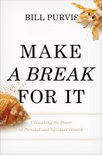
Review: "Make a Break for It" by Bill Purvis

Bill Purvis.  Make a Break for It: Unleashing the Power of Personal and Spiritual Growth.  Grand Rapids, MI: Zondervan, 2016.  216pp.  $21.99.

According to the Merriam-Webster Dictionary, one defines “direction” as “the path along which something moves, lies, or points” or “an order or instruction to be followed.”  Both are fitting definitions when applied to the realm of spiritual development.  On one hand, we, from the moment we are born to the moment we expire, are moving along a direction.  We have a starting point (mine was in December 1978, in Huntington, West Virginia), and we have will have a stopping date (still working on that one).  The time in between our starting point and our stopping point is the direction of our life, or “trajectory,” as one of my college Bible professors referred to.  We begin, we move along for a while, then we end.  Direction.
            On the other hand, we, from the moment we are born to the moment we expire, are following directions.  Some of those directions are instinctual (crying when we are spanked at birth), some of those directions are intentional (the directions that I give my students in order to complete a paper or project), and some of those directions are accidental (pointing blindly at a wrench when fixing an appliance and your son actually brings you the correct item).  Regardless of the purpose of the direction, we will find ourselves following directions throughout the course of our direction of life.  We begin, we move along for a while, then we end.  Direction.
            Yet, should life not be more than simply follow directions as we follow along a direction?  This is the idea that is at the heart of Bill Purvis’ new book Make a Break for It.  As he writes in the introduction, “Do you ever feel as if your whole life is stuck in a traffic jam, on idle as you wait. . .and wait. . .and then wait some more for a lane to open up so you can get on the fast track to where you want to be?  Or maybe you feel more like you’re in a roundabout.  You keep going around in circles, driving past one exit after another because you don’t have any idea where you’re supposed to go next” (p. 11).  As Purvis argues throughout his book, life should be more than beginning, moving along for a while, and then ending.
            Purvis’ story begins somewhat like you would imagine a published testimony to start—a young man trapped in a broken life fueled by vices.  Yet Purvis’ story is not your usual testimony material.  His testimony includes being stabbed in the heart by a pimp who tried to murder him and his friend.  Just let that line sink in for a moment.  Escaping that moment led Purvis to a true “come to Jesus moment”—a hospital bed confessional that leads to a young man committing his life to not only follow Christ but seek to lead others to Christ. 
However, before you part company with Purvis 20 pages in because you—like me—have a boring testimony, I encourage you to stick with him.  This is not Augusten Burroughs’ This Is How, a brash, abrasive therapy session where you almost feel guilty for not being more broken.  [BTW, I like Burroughs’ book.]  Nor does this delve into sappy sentimental religiosity.  The chapters that follow Purvis’ testimony are carefully-crafted conversations about life, redemption and the self-sacrificial love of God.  It is a book about living well, about moving past excuses and criticisms, about choosing mentors well, and about living the adventure of life. 

This book is about direction—about beginning, about moving along for a while, and about ending.  Yet, Purvis argues, all of this direction should be taken with purpose—purpose which is found in God because it is only God who can give us direction for our direction in life.  So, in Purvis’ words, make a break for it—break away from your direction-less life and allow this redeemed journeyman guide you to a better direction for your life.

Friday, August 21, 2015

DC Movies: First to Worst

Last week, I ranked Marvel's live-action films (at least the 37 I have seen) from first to worst. Thanks to everyone who read the list and have asked me about it since.

This week, I'm tackling the DC films. As I mentioned last week, I am more of a DC guy. I grew up with Batman, Superman and the Justice League, and so I feel more invested in their comic universe. However, I am by no means a "comic nerd," meaning that I do not know every single thing about every single character in every single story-line. I just like the stories and the characters.

That being said, I have to admit something: DC, overall, is much better at animated films that live-action. They just haven't done that many, and the non-Batman or early-Superman ones have just not been that good. In short, this list is live-action films...and I basically just gave numbers to the ones after 10 in order to make a publishable list. So here goes:
  1. The Dark Knight (2008) -- This film is so good for so many reasons: Bale was at this best as Batman, Heath Ledger gave us one of the great screen villains of all time, and Nolan proved to a larger audience that he is a mater filmmaker.
  2. Superman (1978) -- Christopher Reeves in that plain-style Superman suit squaring off against Gene Hackman in a role he was born to play (Lex Luthor) with John Williams' incredible score playing in the background. You know you dressed up at least once as Superman for Halloween because of this movie. Also, it set the bar for everything that has come after, only to be outdone by the aforementioned The Dark Knight.
  3. Batman Begins (2005) -- In a lot of ways, this served as a reboot not only for the Batman film franchise but for superhero films in general. If you don't believe me, just look at what came between Batman Returns (1992) and Iron Man (2008) and honestly tell me those were some glory years (the Tobey McGuire-Spider-Man films aside).
  4. Batman (1989) -- This is the film that captured me as a Batman fan and drove me to the comics to learn more about this silent guardian...this masked vigilante...this caped crusader...this dark knight. Whether they say it or not, this is the film all comic-book and superhero filmmakers look to for both inspiration and challenge.
  5. Superman II (1980) -- The empire struck back that same year, which overshadowed Superman's return a little. Thankfully Lex Luthor (Gene Hackman) was there to enchant audiences back to Metropolis.
  6. The Dark Knight Rises (2012) -- Of Nolan's Dark Knight trilogy, this is my least favorite simply because it is not as good as The Dark Knight. It feels rushed in spots. It's still better than the rest of the films on the list and many on the Marvel list. Yet it was a letdown in terms of ending Nolan's epic storyline.
  7. Batman Returns (1992) -- You could make a case that this is better than The Dark Knight Rises. You could probably make a strong case. It's a really good sequel to the 1989 Batman film and a good overall sequel film in general. Danny DeVito does a good job as Chester Cobblepot/Penguin; yet the Penguin is just a hard-to-believe character that it comes in just a step behind TDKR.
  8. Batman: The Movie (1966) -- The was campy Batman (and campy 1960s movie-making) at it's finest.
  9. Batman Forever (1995) -- I realize that I am probably going to catch some flack for this because Joel Schumacher directed this. However, if you pretend almost anyone else directed this, then you see that it's actually pretty good. It's right on the border of campy, and it suffers from it's own inflated ego due to the casting choices of Jim Carry (Riddler) and Tommy Lee Jones (Two-Face) in superbly fun roles. However there was little to not like about this film.
  10. Watchmen (2009) -- This is arduously long and difficult to stick with (especially if you have not read the graphic novel), however it's better than everything else on this list.
  11. Man of Steel (2013) -- Yes, there are a lot of problems with this film. However, like Watchmen, it's better than everything else on this list.
  12. Superman Returns (2006) -- Bryan Singer left X-Men: The Last Stand to direct this? Are we sure that actually happened? Maybe Brett Ratner tricked Singer into thinking he was directing X-Men: The Last Stand. Regardless, this film is just flat and just flat boring. Even Kevin Spacey's well-played turn as Lex Luthor (in a way very much that draws from Hackman) couldn't help Sups soar here.
  13. Swamp Thing (1982) -- Just let this sink in for a moment, remind yourself you probably saw it on USA or SyFy once, and let's move on.
  14. The Return of Swamp Thing (1989) -- After seeing this and realizing that it only had a limited release, you wonder how the rest of the films on this list ever saw a single silver screen.
  15. Superman III (1983) -- After-school special about the dangers of tobacco and how smoking can ruin your dreams...in the form of a Superman film that tried really, really hard to be a comedy.
  16. Superman IV: The Quest for Peace (1987) -- Getting scratched robs Superman of his power? Really? On a lighter note, the "Honest Trailer" for this is hysterical.
  17. Steel (1997) -- You can't actually prove that I saw this. I mean, I did...and I felt horrible as a result. But you still can't prove that I saw it.
  18. Green Lantern (2011) -- I'm just finishing off the list at this point. And DC was scrapping the bottom of the barrel here. Martin Campbell's stellar directorial career still hasn't recovered.
  19. Catwoman (2004) -- (sigh)
  20. Batman and Robin (1997) -- When your cast and director apologize for making the film, you know it's going to be awful.
  21. Supergirl (1984) -- I hear the new series is actually good...so we'll pretend this didn't happen.
So there you go. My opinion of the DC films. Got something you would like me to review or list next week? Leave me a comment.

Wednesday, August 19, 2015

Leadership Lessons I Learned from "Jurassic World" (With Apologies to Alissa Wilkinson)

I am luke-warm when it comes to my opinion of Jurassic World, the recent and 4th installment of the Jurassic Park franchise. I had issues with when I went to see it, issues that were validated when I saw it.  This, however, is not a review of Jurassic World. Alissa Wilkinson gave a great review of the film.  [You should listen...it is hysterical.] That being said, there are a few lessons that I learned related to leadership from the film, lessons that I offer here:

1.  Don't Lead Out of Your Experience-Level

One of the big problems with the JP storyline is that humanity is re-creating dinosaurs simply because they can. As we see in each of the films, an idealist (or greedy accountant) thinks they can control these wild, confused creatures. Then reality sets in through some form of catastrophe that eventually leads to a larger catastrophe. Let's be honest...humanity has no experience when it comes to creating, controlling or corralling dinosaurs!

Yes leaders need to push themselves to grow and develop in their craft. Yet, in order to not bring the organization down in a flaming disaster, we must lead out of our limits. There are areas of leadership that I am just not good at. I need to be mature enough to delegate or collaborate with another leader to make sure the vision stays on track. There are times for jumping off the deep-end and launching out in faith. Yet, when we do that, we are actually trusting that God will guide us. From a day-to-day basis, however, we must lead out of our experience rather than trying to convince everyone that we know how to corral man-earing dinosaurs.

2.  High Heels Don't Work in the Jungle!

Now, don't get me wrong: Bryce Dallas Howard is an excellent actress (Lady in the Water and Twilight aside...we all make mistakes). Even when playing Gwen Stacy in Spider-Man 3, she has always come across as an articulate and intelligent woman. Her pedigree is solid. However...wearing high heels in the jungle or running through corridors from a dinosaur? Uh, no. That's just silly.

A scientist wearing sneakers or boots walking through the jungle is useful; a scientist wearing high heels walking through the jungle is a liability. When facing conflicts or challenges, leaders have a limited number of tools available, and we must use the ones that will be serve the situation. That also means that we may have to "go barefoot" because what we have with won't work. 

3.  Choose Your Team Wisely

The "alpha male" concept is huge in Hollywood. It's huge in self-help psychology. And it's huge in some streams of evangelical Christianity. However, an "alpha male" as a velociraptor trainer? Uh-huh. Let me know how that works out for you. As we see in the film, the only reason why the velociraptors allow Owen (Christ Pratt) to dominate them is so that they can gang up on Owen and the other humans and eat them (BTW, just like they did in Jurassic Park). Additionally, N-Gen are the bad guys in the JP universe. So why do these guys keep working with them?

What this means for leaders is that we must be careful in picking our teams and careful is whose support we draw from. Often leaders, especially when they are new to a organization, will fall prey to the "velociraptors" present -- those who got the last leader ousted, those who are looking to advance themselves through your failures or those who are jaded because you got the position they wanted. Additionally, we need to be confident enough in our own personality, training and experience to be courageous enough to lead. There is a place for trusting enemies, however we must always do so cautiously. Personally, I have been burned by those that I disagreed with because I thought they supported my vision only to be caught in a crossfire when their true motives came out.

I hope this list is helpful. Got another idea that you want to share? Leave me comment below or send me an email.

Like what you read? Follow me on Twitter (@DrRobOlynn)!

Monday, August 17, 2015

Semicolon Theology

Did you hear?  RNS columnist Jonathan Merritt got his first tattoo yesterday! Okay...that might not be the most startling news from yesterday. [Although, to be honest, I have a friend who is still waiting on me to get my first one...17 years later.] And, in all reality, Christians getting tattoos shouldn't even raise an eyebrow.

So why mention this little personal tidbit from Jonathan's life? Well, it's because of why he decided to get the tattoo specifically. He decided on a semicolon, and did so because it "is a reminder that there are times in a story when the author could choose to quit, but decides instead to go on." There is a lot of truth in that statement, spiritually speaking.

We are the authors of our own stories, and some of out storytelling is good and some of it is not so good. My comment back to Jonathan came from my favorite prayer in the Bible -- Psalm 30. We see the fascinating reality of faith demonstrated for us in a single verse: "By your favor, O LORD, you had established me as a strong mountain; you hid your face, I was dismayed" (NRSV).

Did you see what happened there? In the space of a semicolon, the poet's life changed from success to failure, from living high on the mountain to languishing down in the valley. And in just the space of the semicolon. The New Living Translation separates these as two sentences, which helps us see the idea here a little more clearly -- our life can change in just the space of a moment.

Whether it being in a traffic accident like I saw on Friday, walking out of a job interview or leaving someone at the table at Starbucks because we just broke up with them, our lives can change in just a moment. In one moment, life is stellar -- like Christopher Nolan/The Dark Knight stellar. Then, without any warning, the bottom falls out and we beg for God to intervene -- like I might have done when I saw the recent Fantastic 4 film with my son.

The point is, change is the one constant to life. That does not mean, however, that God is not present. It simply means that life happens. It means that we decide to go forward rather than quit when life gets too hard. Because, as we see at the end of Psalm 30, if we endure, then we will see God turn our mourning to dancing and clothe us with everlasting joy.