Showing posts with label Movies. Show all posts

Monday, April 23, 2018

Star Trek Films, Ranked from Best to Worst

Yes, I am a Trekkie.  Not quite one that has an accurate cosplay outfit stuffed away in his closet, however that it not to say that I did not build a TNG bridge set in my parents' basement and act out my own stories when I was kid. 

I made what I could out of cardboard, construction paper and markers (i.e., communicator badge, pips, bridge stations) and saved up to buy what I couldn't make (a phaser and tricorder).  I developed my own series and wrote a handful of scripts, improvising other adventures.  Yes, dear tweeps, I was a Star Trek nerd.

Yet, as with the population's general enjoyment of Star Trek, my love of Star Trek waned once I graduated from high school.  I wanted to continue my love affair with the Enterprise and her crew, however the films following First Contact did not help.  Additionally, I never could get into Deep Space Nine (I mean Star Trek is about exploring space...you cannot do that when you are stuck on a space station) or Voyager.  By the time Enterprise came along, I had hidden my love for boldly going where no one had gone before deep within my soul.

Then came the rebooted films from J. J. Abrams.  Old feelings of warmth and enjoyment sprung to the surface of my typically logical soul.  I even began to wonder if my parents had kept any of my old Trek artifacts in their garage.  I went to see this new incarnation of Captain Kirk and company ... and was pleasantly surprised.  I liked what I saw.  Was it spot-on?  No.  Were there (significant) problems?  Absolutely.  Was it better than fan-fiction?  Yes.  And, in the words of ScreenJunkies, "Star Trek is cool again!" 

How the new voyages of the new Starship Enterprise are not the only reason why I am once again finding my joy in Star Trek.  Last year, I reviewed The Gospel According to Star Trek: The Original Crew by Kevin C. Neece.  The first fully faith-based discussion of Gene Roddenberry's sci-fi series brought me humbly before Netfilx to go back and re-watch the entire original series, animated series and original series films.  Now I am proudly and comfortably back in my universe, working through The Next Generation (I am almost finished with Season 7 as of this writing).

So, without any further plot exposition, I offer another ranking: the best and worst of the Star Trek films:

  1. Star Trek II: The Wrath of Khan (1982) -- This has it all.  Action, suspense, a genuinely creative sci-fi plot device (the Genesis device) and a compelling villain in Khan (Ricardo Montalban).  Add to this Nicholas Meyer's direction, James Horner's scoring and that scene in Engineering, and you have a film that captures all that Star Trek is meant to be.
  2. Star Trek: First Contact (1996) -- If Q was the great thorn in Captain Picard's side, then the Borg were his one great enemy.  The Borg had spent years ravaging the universe, including the Federation.  In this fun, thrilling time-travel piece, the Enterprise-D crew must prevent the Borg from stopping the first human warp-speed experiment.  In every way, it is made just as well as Star Trek II, which is my only reason for placing it second on this list.
  3. Star Trek VI: The Undiscovered Country (1991) -- In many ways, this film is a espionage thriller set in space.  Although the original cast is starting to show their age, there is still plenty to be excited about.  From the battle sequences to the "who dunnit" detective story, this is not redemption from the abysmal Star Trek V, but also serves as a great send off the Captain Kirk and his crew.
  4. Star Trek IV: The Voyage Home (1986) -- With Spock in tow, the crew begins making their way home only to discover that Earth is on the brink of destruction when a giant alien Hostess cake shows up and begins playing havoc with our weather patterns.  Back to the past they go again to find ... whales.  Yes, "There be whales here!"  This part is hokey, however watching the crew adapt to the twentieth-century is lighthearted and fun.  In many ways, this film is more akin to the original series than any of the other films.
  5. Star Trek: Generations (1994) -- With the series over, producers rushed to get the TNG crew on the big screen.  As a result, this film feels more like an unproduced two-part arc than a feature film.  However it has some good elements -- the production value is certainly ramped up, Malcolm McDowell's villain is one of the better Trek villains.  The highlight here is the scene between Kirk and Picard, where Kirk has one last adventure and Picard finally learns what it means to be "captain of the Enterprise."
  6. Star Trek III: The Search for Spock (1985) -- Who is the central character of the Original Series?  Some will say it was Kirk, some will say that it was a great ensemble.  I say that Spock was the central character, and has remained so throughout all incarnations of Star Trek.  We see it here.  Kirk and company put everything on the line to rescue Spock from the Genesis planet, reuniting old friends.  Unfortunately, Christopher Lloyd's turn as Klingon villain is wasted on an otherwise incomplete story.
  7. Star Trek V: The Final Frontier (1989) -- Okay.  Pretty much from here on, I am simply listing the films.  This film had two things going for it: 1) it proved the original crew needed one mroe outing, and 2) it gave us Kirk giving a soliloquy on why he was a starship captain.  However it also gave us this awful line: "What does God need with a starship?"
  8. Star Trek: The Motion Picture (1979) -- Riding high off of the success of Star Wars, the Enterprise launches onto the big screen to prove that sci-fi could be a big-budget product for flagship studios.  However, this movie is more Kubric than Spielberg, which makes it really difficult to watch...let alone enjoy.  Still, it is visually compelling and has a deep-theme plot.  Too bad it takes so long to get anywhere.
  9. Star Trek: Nemesis (2002) -- There are only two reasons why this film is "better" than Insurrection: 1) Tom Hardy's breakthrough performance as a genetically-engineered Romulan clone of Picard is worth watching, 2) Data becomes human by making the ultimate sacrifice, and 3) it's not Insurrection.
  10. Star Trek: Insurrection (1998) -- Although Sir Patrick Stewart thought this film offered a more accurate portrayal of Captain Picard's character, especially following the final engagement with the haunting Borg (we see Picard's moral center on full display here), and it is just as visually appealing at First Contact (kudos to Jonathan Frakes in this way on both films), this installment is generally considered to be muddled, slow and lacking the ethical depth presented in other TNG episodes that served as inspiration for this film.
You will note that I have not added the Kelvin timeline films to this list.  My reason is simple: the films directed/produced by Abrams are from a new timeline and do not play into the progression of events portrayed in the Original Series, the Next Generation and its "spin-offs" (of which I am not including Discovery).  I enjoy these films, however I think they must stand apart from the canon.  If, however, you are interested in hearing my thoughts, let me know. 

Friday, August 21, 2015

DC Movies: First to Worst

Last week, I ranked Marvel's live-action films (at least the 37 I have seen) from first to worst. Thanks to everyone who read the list and have asked me about it since.

This week, I'm tackling the DC films. As I mentioned last week, I am more of a DC guy. I grew up with Batman, Superman and the Justice League, and so I feel more invested in their comic universe. However, I am by no means a "comic nerd," meaning that I do not know every single thing about every single character in every single story-line. I just like the stories and the characters.

That being said, I have to admit something: DC, overall, is much better at animated films that live-action. They just haven't done that many, and the non-Batman or early-Superman ones have just not been that good. In short, this list is live-action films...and I basically just gave numbers to the ones after 10 in order to make a publishable list. So here goes:
  1. The Dark Knight (2008) -- This film is so good for so many reasons: Bale was at this best as Batman, Heath Ledger gave us one of the great screen villains of all time, and Nolan proved to a larger audience that he is a mater filmmaker.
  2. Superman (1978) -- Christopher Reeves in that plain-style Superman suit squaring off against Gene Hackman in a role he was born to play (Lex Luthor) with John Williams' incredible score playing in the background. You know you dressed up at least once as Superman for Halloween because of this movie. Also, it set the bar for everything that has come after, only to be outdone by the aforementioned The Dark Knight.
  3. Batman Begins (2005) -- In a lot of ways, this served as a reboot not only for the Batman film franchise but for superhero films in general. If you don't believe me, just look at what came between Batman Returns (1992) and Iron Man (2008) and honestly tell me those were some glory years (the Tobey McGuire-Spider-Man films aside).
  4. Batman (1989) -- This is the film that captured me as a Batman fan and drove me to the comics to learn more about this silent guardian...this masked vigilante...this caped crusader...this dark knight. Whether they say it or not, this is the film all comic-book and superhero filmmakers look to for both inspiration and challenge.
  5. Superman II (1980) -- The empire struck back that same year, which overshadowed Superman's return a little. Thankfully Lex Luthor (Gene Hackman) was there to enchant audiences back to Metropolis.
  6. The Dark Knight Rises (2012) -- Of Nolan's Dark Knight trilogy, this is my least favorite simply because it is not as good as The Dark Knight. It feels rushed in spots. It's still better than the rest of the films on the list and many on the Marvel list. Yet it was a letdown in terms of ending Nolan's epic storyline.
  7. Batman Returns (1992) -- You could make a case that this is better than The Dark Knight Rises. You could probably make a strong case. It's a really good sequel to the 1989 Batman film and a good overall sequel film in general. Danny DeVito does a good job as Chester Cobblepot/Penguin; yet the Penguin is just a hard-to-believe character that it comes in just a step behind TDKR.
  8. Batman: The Movie (1966) -- The was campy Batman (and campy 1960s movie-making) at it's finest.
  9. Batman Forever (1995) -- I realize that I am probably going to catch some flack for this because Joel Schumacher directed this. However, if you pretend almost anyone else directed this, then you see that it's actually pretty good. It's right on the border of campy, and it suffers from it's own inflated ego due to the casting choices of Jim Carry (Riddler) and Tommy Lee Jones (Two-Face) in superbly fun roles. However there was little to not like about this film.
  10. Watchmen (2009) -- This is arduously long and difficult to stick with (especially if you have not read the graphic novel), however it's better than everything else on this list.
  11. Man of Steel (2013) -- Yes, there are a lot of problems with this film. However, like Watchmen, it's better than everything else on this list.
  12. Superman Returns (2006) -- Bryan Singer left X-Men: The Last Stand to direct this? Are we sure that actually happened? Maybe Brett Ratner tricked Singer into thinking he was directing X-Men: The Last Stand. Regardless, this film is just flat and just flat boring. Even Kevin Spacey's well-played turn as Lex Luthor (in a way very much that draws from Hackman) couldn't help Sups soar here.
  13. Swamp Thing (1982) -- Just let this sink in for a moment, remind yourself you probably saw it on USA or SyFy once, and let's move on.
  14. The Return of Swamp Thing (1989) -- After seeing this and realizing that it only had a limited release, you wonder how the rest of the films on this list ever saw a single silver screen.
  15. Superman III (1983) -- After-school special about the dangers of tobacco and how smoking can ruin your dreams...in the form of a Superman film that tried really, really hard to be a comedy.
  16. Superman IV: The Quest for Peace (1987) -- Getting scratched robs Superman of his power? Really? On a lighter note, the "Honest Trailer" for this is hysterical.
  17. Steel (1997) -- You can't actually prove that I saw this. I mean, I did...and I felt horrible as a result. But you still can't prove that I saw it.
  18. Green Lantern (2011) -- I'm just finishing off the list at this point. And DC was scrapping the bottom of the barrel here. Martin Campbell's stellar directorial career still hasn't recovered.
  19. Catwoman (2004) -- (sigh)
  20. Batman and Robin (1997) -- When your cast and director apologize for making the film, you know it's going to be awful.
  21. Supergirl (1984) -- I hear the new series is actually good...so we'll pretend this didn't happen.
So there you go. My opinion of the DC films. Got something you would like me to review or list next week? Leave me a comment.

Wednesday, August 19, 2015

Leadership Lessons I Learned from "Jurassic World" (With Apologies to Alissa Wilkinson)

I am luke-warm when it comes to my opinion of Jurassic World, the recent and 4th installment of the Jurassic Park franchise. I had issues with when I went to see it, issues that were validated when I saw it.  This, however, is not a review of Jurassic World. Alissa Wilkinson gave a great review of the film.  [You should listen...it is hysterical.] That being said, there are a few lessons that I learned related to leadership from the film, lessons that I offer here:

1.  Don't Lead Out of Your Experience-Level

One of the big problems with the JP storyline is that humanity is re-creating dinosaurs simply because they can. As we see in each of the films, an idealist (or greedy accountant) thinks they can control these wild, confused creatures. Then reality sets in through some form of catastrophe that eventually leads to a larger catastrophe. Let's be honest...humanity has no experience when it comes to creating, controlling or corralling dinosaurs!

Yes leaders need to push themselves to grow and develop in their craft. Yet, in order to not bring the organization down in a flaming disaster, we must lead out of our limits. There are areas of leadership that I am just not good at. I need to be mature enough to delegate or collaborate with another leader to make sure the vision stays on track. There are times for jumping off the deep-end and launching out in faith. Yet, when we do that, we are actually trusting that God will guide us. From a day-to-day basis, however, we must lead out of our experience rather than trying to convince everyone that we know how to corral man-earing dinosaurs.

2.  High Heels Don't Work in the Jungle!

Now, don't get me wrong: Bryce Dallas Howard is an excellent actress (Lady in the Water and Twilight aside...we all make mistakes). Even when playing Gwen Stacy in Spider-Man 3, she has always come across as an articulate and intelligent woman. Her pedigree is solid. However...wearing high heels in the jungle or running through corridors from a dinosaur? Uh, no. That's just silly.

A scientist wearing sneakers or boots walking through the jungle is useful; a scientist wearing high heels walking through the jungle is a liability. When facing conflicts or challenges, leaders have a limited number of tools available, and we must use the ones that will be serve the situation. That also means that we may have to "go barefoot" because what we have with won't work. 

3.  Choose Your Team Wisely

The "alpha male" concept is huge in Hollywood. It's huge in self-help psychology. And it's huge in some streams of evangelical Christianity. However, an "alpha male" as a velociraptor trainer? Uh-huh. Let me know how that works out for you. As we see in the film, the only reason why the velociraptors allow Owen (Christ Pratt) to dominate them is so that they can gang up on Owen and the other humans and eat them (BTW, just like they did in Jurassic Park). Additionally, N-Gen are the bad guys in the JP universe. So why do these guys keep working with them?

What this means for leaders is that we must be careful in picking our teams and careful is whose support we draw from. Often leaders, especially when they are new to a organization, will fall prey to the "velociraptors" present -- those who got the last leader ousted, those who are looking to advance themselves through your failures or those who are jaded because you got the position they wanted. Additionally, we need to be confident enough in our own personality, training and experience to be courageous enough to lead. There is a place for trusting enemies, however we must always do so cautiously. Personally, I have been burned by those that I disagreed with because I thought they supported my vision only to be caught in a crossfire when their true motives came out.

I hope this list is helpful. Got another idea that you want to share? Leave me comment below or send me an email.

Like what you read? Follow me on Twitter (@DrRobOlynn)!

Friday, August 14, 2015

Marvel Movies: Best to Worst

I know, I know.  It's been awhile since I've "shared."  Hey, that's life for some of us.  However, after watching the latest "in-stall-ment" of the Fantastic Four movie franchise, I would offer my opinion on how it ranks against the 35 or so other Marvel films that I have seen.

Note to the Nerdlings: 1) I am actually a DC fan who enjoys Marvel films.  2) I have almost no stake in any of these films, except the Captain America and Cap affiliated films.  3) This is simply my opinion -- I am not Kevin Feige!

With all of this in mind, let's look at the list.  I have broken it down into chunks for readability.  I should note that I am using the list that is available on Wikipedia, and I am only ranking the films that I have actually seen (so there are a couple of early films, direct-to-video sequels, and some TV films that I am not including).

The Best of the Bunch (#1-10)
  1. Iron Man (2008) -- Yes, I said it.  It is the best stand-alone Marvel film.  It set the bar and is, therefore, the best.
  2. Spider-Man 2 (2004) -- This film proved that sequels can be better than the origin story, and is # 2 only because it is a sequel.
  3. Captain America: The Winter Soldier (2014) -- Absolutely better than the original...even "Rotten Tomatoes", "Cinema Score" and "Screen Junkies" thought so.  This is one that I will watch just because I own it.
  4. The Avengers (2012) -- Hands-down one of the best ensemble films around!
  5. Spider-Man (2002) -- Marvel learned that "With great power, comes great responsibility" when it comes to making comic-book movies.
  6. X-Men (2000) -- For better or for worse, Fox's only successful superhero franchise (to date) has been an important cultural, political and spiritual talking point.
  7. Guardians of the Galaxy (2014) -- This one is just plain fun, and, I think, set some new standards for science fiction films.
  8. Ant-Man (2015) -- Surprise! Marvel took one their darker characters and stayed truthful to the origin and evolution of this character in a way that even my 9-year-old (non-comic-book fan) daughter absolutely loved.
  9. The Avengers: Age of Ultron (2015) -- After seeing it three times, I realized that while it is better than the other 25 films on this list, it just was not as good as the original films.  I liked the evolved interactions between the team, the James Spader-voiced Ultron was superb, yet it also came across at times at trying to be better than the original.
  10. Captain America: The First Avenger (2011) -- Cap is essential to the Marvel Universe in so many ways.  And while the origin story was slow in parts, this was certainly a Joe Johnston film: it was respectful to the origin story, it was respectful to the "gosh, golly wilikers" era, and it told a decent story.  Yes, the "crashing the plane in the ice rather than landing it safely in NYC" rather silly, but the movie, overall, was great.
Not as Good, But Better than Others (#11-20)
  1. Iron Man 2 (2010) -- Better known as "Nick Fury: Origin Story"
  2. Thor (2011) -- Not bad...definitely better than several others...but not stellar either. 
  3. X2 (aka, X-Men 2: X-Men United) (2003) -- Foreshadowing...lots of foreshadowing.
  4. X-Men: First Class (2011) -- Post-Brett Ratner.
  5. X-Men: Days of Future Past (2014) -- Maybe my memory is starting to get a little hazy.  There have been so many X-Men movies.  It's almost like Fox is trying to milk this franchise for all it's worth...
  6. Thor: The Dark World (2013) -- Again, not bad...definitely better than several others...but not stellar either.
  7. The Incredible Hulk (2008) -- The non-Ang Lee one.  Pretend Bill Bixby is playing Banner and it's actually not bad.
  8. Blade (1998) -- Actually, not a bad film.  Mythology is about as bad as the Underworld mythos, yet watching Wesley Snipes go all Wesley Snipes on some vampires is pretty cool.
  9. The Wolverine (2013) -- Storyline aside, this is a decent stand-alone superhero film.
  10. Iron Man 3 (2013) -- Let's be honest...this was simply to pass the time until Cap and Thor got their sequels made.
When Executives Make Dollar-Based Decisions (#21-30)
  1. The Amazing Spider-Man (2012) -- Did we really need a new Spider-Man this soon?
  2. X-Men Origins: Wolverine (2009) -- Are we completely sure Brett Ratner didn't make this?  I mean, a Deadpool who can't speak?  Where's the fun in that?
  3. Spider-Man 3 (2007) -- It's got to go somewhere on the list.
  4. Blade II (2002) -- Fun fact: Guillermo del Toro directed this one.  *Ding*
  5. X-Men: The Last Stand (2006) -- There was nothing "last" about this...Brett Ratner is still making movies somehow.
  6. Hulk (2003) -- The Ang Lee-directed one.  R.I.P. Bill Bixby.
  7. Fantastic Four (2005) -- Sympathy vote, plain and simple.
  8. Howard the Duck (1986) -- A really bad movie that we really like.
  9. The Punisher (2004) -- sigh
  10. The Amazing Spider-Man 2 (2014) -- Unnecessary hipster reboot.
Scrapping the Bottom of the Barrel (#31-37)
  1. Blade: Trinity (2004) -- When Ryan Reynolds actually steals the show (and not as Deadpool).
  2. Fantastic Four: The Rise of the Silver Surfer (2007) -- So...who was the film actually supposed to be about?  And that's the best Fox could do with Galactus?
  3. Fantastic 4 (2015) -- The trailer was literally better than the movie.  Most of the scenes in the trailer weren't even in the movie...and they were better than what made the movie!
  4. Ghost Rider (2007) -- I still have not actually seen all of it...I can't force myself to finish it.
  5. Daredevil (2003) -- Hey, I hear the television series is excellent.
  6. Elektra (2005) -- Jennifer Garner grew up in West Virginia...I was born in West Virginia...that was my justification for seeing this and I then promptly repenting of my cinematic sin.
  7. The Fantastic Four (1994) -- I have only seen clips...and they are awful.
So, there you go.  My ranking of the Marvel films from best to worst.  Sorry about the numbering; code-writing is not my thing.  

Feel free to leave me a comment below!

Thursday, December 12, 2013

Courage

I enjoy spending time with my son.  Usually that time is spent eating at Five Guys, wrestling or playing video games.  To date, we have never crash-landed on a desolate planet and had to fight our way through a jungle in order to call home for help.  While that has not happened to me or my son, it is the basic storyline for the M. Night Shyamalan’s summer 2013 sci-fi film After Earth.  In the film, a military hero who has recently decided to retire from battle in order to train troops and spend more time with his family (Will Smith) is called out on an exploration mission with a crop of newly-trained soldiers, including his son (Jaden Smith, Will Smith’s son).  During the course of the mission, their ship crash-lands on a desolate planet, one where everything has evolved to kill humans.  Ironically, the planet is Earth, our original home-world.  Raige (Will Smith) discovers that the ship ripped in half during the crash and that the homing beacon is in the half of the ship on the other side of the planet.  (Well, not really, however it is a really long way away.)  Unable to go on the mission, Raige sends his son, an untested trainee, to recover the beacon.  To do this, the young man will have to muster something within himself that he does not believe he has—courage.  Yet, through each near-disastrous encounter, the young man summons the courage he needs to complete his mission and save himself and his father.

In his sermon “But If Not,” Martin Luther King, Jr., addressed the issue of courage by connecting it to our faith in God.  In the midst of the Civil Right Movement, King witnessed many cave under the pressures of racism while also seeing many others rise through the flames of hatred to achieve peace.  In response to this, King spoke about how we approach persecution and struggle.  Some of us, he said, approach these issues from an “if” perspective: if we meet oppression; if we encounter hatred; if we endure suffering.  King noted that people who have this approach often buckle under the pressure because they are not living courageously and therefore do not trust fully in God.  On the other hand, King noted, those who live with a “though” attitude endure through the struggles because they trust fully in God.  They know that hardship and crisis will come.  Yet they have staked their tents on God’s soil and do not plan on being removed from the Promised Land.  “Though I may walk through the Valley of the Shadow of Death, I will fear no evil,” these folks would say.  Faithfully courageous people do not live in fear of suffering.  They know that will come and are ready to meet it head-on.

These stories remind me of a passage in Psalms 27 where the poet calls for God for teach him of God’s way so that he can triumphantly overcome his adversaries (27:11-14).  There is one line in the movie that relates well with this passage.  Raige says, “Danger is very real.  However fear is in our minds.”  The person who lives with King’s “though” faith realizes that the world is a dangerous place.  However, we have confidence in God that God will bring us through whatever comes our way and that we “shall see the goodness of the LORD in the land of the living” (Psalm 27:13).

Wednesday, October 23, 2013

With Great Power Comes Great Responsibility


Note: This is a continuation of a series of posts from my Advanced Preaching students at Kentucky Christian University.  Feel free to leave them some comments below.

Guest Author: Cody Julian (@TheCjulian)

With great power comes great responsibility. These are the last words Peter Parker heard from his uncle before he was killed. Before Peter became spiderman. These last words meant something to him. They changed him. They meant that he would have to put others before himself. That he needed to be man before he could be someones hero. 
So often in todays world we see so few men and more and more boys. We do not want to take responsibility for our actions. We make quick decisions and then regret them later. We say “no” or “yes” to something and then later we say the opposite. I have been guilty of this myself. I change my mind. I second guess myself. I make mistakes. I hurt people. This is not how a christian man should act. In James 5:12, James says “But above all, my brothers, do not swear, either by heaven or by earth or by any other oath, but let your “yes” be yes and your “no” be no, so that you may not fall under condemnation.”  Basically this is saying say what you mean and mean what you say. Do not go back on your word. Be responsible and trustworthy. If anyone had come seen any of these bad traits I have mentioned then he would not be a very good super hero now would he? People would not see him as someone they could rely on when they need help. Man are supposed to be leaders not being timid and unable to make decisions. They should be trustworthy, not spiting lie after lie. 

Do not let yourself become a man who no one can count on. Do not be the man that regrets his decisions. Do not be the man who loses people from his life because of his actions. Be the responsible man. Be the honest man. Be the Godly man. Remember that with great power comes great responsibility. 

Monday, October 7, 2013

Unknowable God

Note: This is a continuation of posts from my Advanced Preaching students at Kentucky Christian University.  I (and they) would appreciate some comments and feedback!

Guest Author: Eli Cox (@ElijahReece)

I do not know if you have seen it, actually you probably have not, but this new movie came out recently called “A Strange Brand of Happiness.”  Basically, this movie is about a bachelor named Joe who is aimlessly searching for himself, while also chasing after a woman.  Joe is a talented artist, but does not know how to use his talent as a career fully.  We see throughout the movie that he believes in some higher being, but Joe lives in a state of confusion beyond this knowledge.  In the end of the movie, Joe sees how he can use his talent in a more productive way, he gets the girl, and he comes to terms to believe in God.  He is still very confused about many of the things with God, but admits to His very clear presence in his own life.

I could not help but think about another story when I saw this movie.  It is a story of a man, a husband.  He spends his life worshipping many different gods.  He had a god for the rain, and one for the sun; one for basically any aspect of his life.  And he lived his life that way; making alters to these different gods in worship of them.  But this man came to a place in his life, a place of confusion; he knew that there was something else.  There had to be someone else causing the things in his life to happen, some other god.  So, out of total confusion and probably some anger therefore, this man constructed an alter to the unknown God, or more correctly translated: “to the unknowable God.”

“So Paul took his stand in the open space at the Areopagus and laid it out for them. “It is plain to see that you Athenians take your religion seriously. When I arrived here the other day, I was fascinated with all the shrines I came across. And then I found one inscribed, to the god nobody knows [literally, to the unknowable God]. I’m here to introduce you to this God so you can worship intelligently, know whom you’re dealing with.  The God who made the world and everything in it, this Master of sky and land, doesn’t live in custom-made shrines or need the human race to run errands for him, as if he couldn’t take care of himself. He makes the creatures; the creatures don’t make him. Starting from scratch, he made the entire human race and made the earth hospitable, with plenty of time and space for living so we could seek after God, and not just grope around in the dark but also actually find him. He doesn’t play hide-and-seek with us. He’s not remote; he’s near. We live and move in him, can’t get away from him!” (Acts 17:22-27)

Wednesday, October 2, 2013

Changing His Attitude Will Take a Miracle

Note: This is the first in a series of guest posts from my Advanced Preaching students at Kentucky Christian University.  I (and they) would appreciate your feedback!

Guest Author: Hunter Fraley (@hunterfraley)

I have struggled with having faith before, as I am sure we all have.  Stubbornness and fear of change are two of the very few things that we as humans do well.  I believe one of Jesus’ greatest miracles is breaking down the barriers men and women have built around their hardened hearts.  How many of us could say that only a near-death experience has saved us from our stiff-necked selves? That is exactly the case for the eponymous protagonist of 2008’s Henry Poole is Here.

Caring little about the logistics of the purchase, Henry Poole is more than willing to do anything it takes to close the deal, including overpaying for the property.  His days are spent drinking and eating whatever junk food he shovels into his mouth.  The monotony of his unhealthy lifestyle is only broken by his neighbors, a cavalcade consisting of a devout catholic, a struggling divorcee, and her mute 7 year old daughter.  To make matters worse, his neighbor Esperanza (devout Catholic) believes she can see the face of Jesus in a botched stucco job on his patio wall.  Much to the chagrin of Poole, she spends copious amounts of time sneaking into his backyard with her church friends to admire the stain.  Poole eventually befriends the divorcee (appropriately named Dawn)and her daughter Millie.  It is then that we learn that he has been diagnosed with an unnamed terminal illness.

To everyone but Poole, the stain seems to have a restorative quality, healing those who touch it.  The first claims are easy for him to dismiss, however, when Millie begins to speak for the first time in over a year, we would assume this would be enough evidence for Poole to be willing to have faith and try himself.  He struggles with the decision one night and when his fingers were a mere few inches from the stain, he lets the fall limp and slowly turns to saunter back inside.

A certain scripturecomes to mindas I remember this scene.  Matthew 13: 14-15 references a prophecy of hard-heartedness being fulfilled.  It speaks of hearing yet not understanding, seeing yet not perceiving; however, it is not because ability is lacking, but because the ears have been filled and the eyes taped shut willingly.  These conditions are attributed to a heart calloused by indifference and doubt.  Poole is a man who has lost hope, truly beaten to a pulp by life.  He refuses to have faith in anything because he is terrified by the thought of being let down by hope 

Things come to a head one day when Poole returns home to realize Esperanza has promised healing to hundreds of people congregated in his backyard.  He promptly smashes through the face of the stain with an axe repeatedly.  Moments after belittling the masses for their blind faith, the weakened structure of the wall allows the roof to partially collapse, crushing Poole beneath the weight of rubble and his own miserable existence.  Poole awakes in the hospital, surrounded by his neighbors who tell him some startling news: his terminal condition had been misdiagnosed.  His dismal outlook had left no room for him to get a second opinion. The stain may have not healed him physically, but it introduced him to people who go on to lead him on a journey to emotional and spiritual healing.  Had his hard-heartedness allowed it, he could have started towards happiness long ago.  What will it take for us to soften our hearts and allow ourselves to be healed?

Friday, April 26, 2013

Pause to Feel a Breeze

I have a confession to make: I have been tired this week, maybe for the last two.  My energy has been down; my creativity has been down; my inertia has been down.  I have been sluggish in getting projects completed.  The work that I have put out the last week or so has not been my best.  In short, I am in a funk.  And, based on conversations with colleagues and students, it seems that I am not alone. 

Life has a way of wearing us down, of sapping our energy to the point that we lament how tired we are.  We eat correctly, we get the right amount of sleep, we take multivitamins, we exercise, we keep our minds active, and yet we find ourselves struggling to make it through the day.  There are a lot of reasons for why weariness comes upon us, yet that is not the problem.  The problem is how we work through the tiredness.  How do we recharge or rejuvenate?

I enjoy the film Fearless with Jet Li because it is not simply a martial arts film.  It is a story about a fighter focused on revenge who became a warrior focused on serenity.  Li plays Huo Yuanjia, the founder of the Jin Wu Sports Federation.  In one scene of the film, while he is living in a quiet farming village, Huo watches the villagers stop what they are doing and stand stoically.  A breeze passes through the village, and all of the people are refreshed by the breeze.  It takes Huo awhile to understand the significance of stopping to feel the breeze.  When he does, it realizes the spiritually cleansing and enriching experience of allowing the moment to wash over him.

Naturally, there is a connection between this moment in the film and our lives as Christians.  The connection between a breeze, the Spirit of God, and rest is seen throughout Scripture, starting with Creation and ending with Revelation.  There are several well-known passages that deal with rest and renewal.  However, the one that I want to share with you is from Hebrews 4.  There, the unknown disciple writes, “So there is a special rest still waiting for the people of God.  For all who enter into God’s rest will find rest from their labors, just as God rested after creating the world.  Let us do our best to enter that place of rest” (4:9-11a, NLT).  Scholars will note that there are both present and future connotations to the use of “rest” in this passage.  Yes, death and eternal life will be “rest” for people of faith. 

Yet, there is also the concept of finding “rest” in our day-to-day lives here.  As Frances Taylor Gench writes, “It is a present reality in our lives when, in the midst of whatever befalls us in our journey of faith, we experience the peace, assurance, and confidence that comes from knowing that our lives are secure in the purposes and promises of God.  That sense of security and well-being is also a foretaste of the eternal rest we will one day enjoy in fullness.”[1]  So, today, if you are feeling a little tired, a little sluggish, I encourage you to take a moment or two and “rest” in the presence of God.  Go outside, walk around, and wait for a breeze.  When it comes, stand still, allow the breeze to wash over you, and rest with God.    


[1]Francis Taylor Gench, Hebrews and James, Westminster Bible Companion (Louisville: Westminster/John Knox Press, 1996), 31. 

Friday, April 19, 2013

Being a Change-Agent, 42-Style


Note: This is the final post in a 3-part series focusing on the recent film 42, which chronicles the early baseball career of Jackie Robinson.

What does it mean to be a “change agent,” one who enacts change in a system?  How does one bring about change in an organization or institution or culture?  What does it take?  To be honest, I have wrestled with this idea of being a “change agent” for a number of years.  I come from a religious tradition that abhors change, more so than most.  “We’ve never done it that way” and “We’ve never tried that” are not defensive mechanisms or organizational checkpoints; they are doctrinal dispositions that must be adhered to in order to be considered orthodox.  Yet, had a change in the religious system not been enacted, bacon would still be illegal to eat and the Christian religion would have never left Palestine.  Change is not a bad thing.  It is only bad when it is brought about for the incorrect reason.


There are plenty of good books on change and leadership dynamics already circulating.  You may want to pick up Os Hillman’s Change Agent: Engaging Your Passion to be the One Who Makes a Difference, John Ellett’s The CMO Manifesto: A 100-Day Plan for Marketing Change Agents, David Hutton’s classic The Change Agent’s Handbook: A Survival Guide for Quality Improvement Champions, or Agents of Change: Strategy and Tactics for Social Innovation by Sanderijn Cels, Jorrit De Jong and Frans Nauta.  There are also plenty of good web-based leaders, such as George Couros and the folks at Global Grassroots, who are encouraging and implementing cultural and social change.  My purposes here are simpler.

At its core, 42 is more than a baseball movie.  As I mentioned earlier this week, 42 is a sports film in that its uses sports as a metaphor for life.  42 is not just a baseball movie that chronicles the “box score” of Jackie Robinson’s life; it narrates the struggle against injustice and oppression.  In many ways, Branch Rickey and Jackie Robinson, at least as they were portrayed in the film, were kindred souls.  To that end, they teach us 4-5 lessons about what it takes to be a change agent:
  1. Awareness—Leaders and change agents have an awareness that something is wrong with the system.[1]  In 42, Rickey tells Robinson that he has always felt that something was wrong with the way that African Americans were treated, especially in sports.  He recounts a story from his days at Ohio Wesleyan College when he regretted not doing more to help a black teammate that had deeply impacted him.[2]  Although it would be forty years before he could finally do something about this, Rickey never forgot the awareness that was stirred within him.
  2. Tough—One of the most compelling scenes in 42 is not when Phillies manager Ben Chapman lashes Robinson with a profanity-laced verbal tirade that forces Robinson into a rage in the dugout only to be calmed by Rickey.  That scene is powerful, yet not as powerful as when Rickey stirs up Robinson earlier in the film in their famous 1945 meeting.  It pains Rickey to use such derogatory language, yet he does so because he needs Jackie to understand the gravity of the situation.  Edwin Friedman says that leadership breaks down and change stalls when we fail “to define a position.”[3]  Rickey did not spare cultural sensitivity, as we are so prone to do today.  Change would not come by being sensitive; it would only come by having “the guts not to fight back.”
  3. Humor—In my experience, humor is the trait often least developed in leadership.  Yet humor can defuse a tense situation or rally an audience behind a speaker (Proverbs 25:11 anyone?).  Sherly Sandberg writes, “Humor can be an amazing tool for delivering an honest message in a good-natured way.”[4]  When criticized by his own advisors about the legitimacy of his idea to integrate baseball, Rickey simply replies, lighting up his cigar with a smile on his face, “Robinson’s a Methodist.  I’m a Methodist.  God is a Methodist.”  Situation defused.
  4. Vision—Vision and awareness are not the same thing.  Awareness is realizing that something is amiss; vision is actually doing something to resolve the situation.  Rickey had a vision—racial integration in baseball.  However, he could not simply pick any ballplayer.  He had to pick the right ballplayer, the one who could stand the jeering and the hatred and the threats.  He had to pick the ballplayer who would respond with soaring homeruns and fantastic fielding rather than balled fists and vicious words.  “Preparation is a major part of vision,” writes Dan Southerland.  “Vision is not just a destination; it is a journey.”[5]  Leaders lead not only for the moment but also for the long haul.
  5. Empowerment—Max DePree says that leaders who bring about change “enable others to express their own gifts.”[6]  As I mentioned above, Branch Rickey needed the right ballplayer.  He needed someone with strength, skill, speed, stamina, and a smile.  Jackie Robinson had all of these things.  Rickey trusted Robinson and Robinson trusted Rickey in return.  Leaders who want to bring about change in their culture or system must empower others around them. 

Malcolm Gladwell says that change is never more than a “tipping point” away, and that it is the little things that will push change over the edge.[7]  I think he’s correct.  Branch Rickey and Jackie Robinson proved it.


[1]Ronald A. Heifetz, Leadership without Easy Answers (Cambridge, MA/London: Belknap Press of Harvard University Press, 1994), 207-208.
[2]Chuck Landon, “Robinson Celebrated Thanks to Ohio Native,” www.herald-dispatch.com/sports/x1925881800/Robinson-celebrated-thanks-to-Ohio-native; accessed 19 April 2013.
[3]Edwin H. Friedman, A Failure of Nerve: Leadership in the Age of the Quick Fix, new ed. (New York: Seabury Press, 2007), 133.
[4]Sheryl Sandberg, Lean In: Women, Work, and the Will to Lead (New York: Alfred A. Knopf, 2013), 86.
[5]Dan Southerland, Transitioning: Leading Your Church through Change (Grand Rapids, MI: Zondervan, 1999), 20.
[6]Max DePree, Leadership is an Art (New York: Dell Publishing, 1989), 78.
[7]Malcolm Gladwell, The Tipping Point: How Little Things Can Make a Big Difference (New York/Boston: Little, Brown and Co., 2000), 12. 


Wednesday, April 17, 2013

Commitment to a Cause Brings Change


Note: This is the second in a three-part series of blogs focusing on 42, the new film from Warner Brothers that focuses on the life of Jackie Robinson.


“Give me a uniform and give me a number of my back, and I’ll give you the guts.”  It was one line that changed the Great American Pastime.  In 1945, following the end of World War II, America’s heroes returned home.  Some of those heroes typically spent their summers playing a game, a simple game of catch where occasionally someone would hit the ball with a stick.  And every one and awhile, that hit would sail so long that crowds would rise from their seats and cheer. 

When you think about it, baseball is probably one of the oddest activities humanity has ever concocted.  It is a lot like golf or polo, where men with sticks attempt to knock a little ball into a small cup.  Only in baseball, the object is a little more complex.  Baseball games can be long and grueling, like soccer or basketball except with less action.  The goal is to score more points than the other team, like football or hockey.  Only baseball is not a contact sport like football and there are (usually) fewer fights.  It was America’s version of the “gentlemen’s game,” originally started by Civil War soldiers to pass the time between skirmishes. 

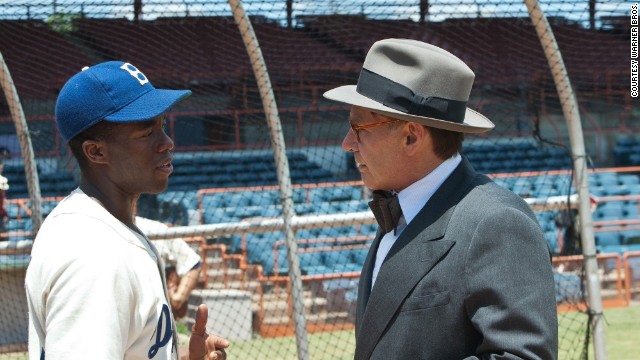
Yet, as American as baseball was, there was one distinct problem—it was horribly one-sided in terms of participants.  It was a white man’s game.  It had always been a white man’s game.  Yes, black men could play.  However they could not play together.  The thought of white men and black men playing together was absurd.  That was until Branch Rickey, the legendary owner of the Brooklyn Dodgers, went on a campaign to change the face of baseball.  In 1945, Rickey put out a call to a young Negro League player named Jackie Robinson, then a shortstop with the Kansas City Monarchs.  Rickey presented Robinson with a challenge—could he, as a lone baseball player, bring about a change that would not only affect the game but also a nation.  However it would not be an easy change to make.  Racism was a deeply-rooted disease in America in the 1940s.  (To be honest, it is still a deeply-rooted disease in some places and with some populations.)  He would insulted and possibly even assaulted for forcing the “color issue” on baseball and the American public.  Robinson was known for his temper.  He often reacted in order to solve racially-motivated problems.  However, Rickey knew better.  This scene in 42 is dripping with compelling emotion.  When Robinson asks if Rickey wants a ballplayer who has the guts to fight back against injustice and racial oppression, Rickey responds by saying that he wants a ballplayer who has “the guts not to fight back.”  “Give me a uniform and give me a number on my back,” Robinson said, “and I’ll give you the guts.”  Commitment to a cause brings about change.

Monday, April 15, 2013

"I'll Give You the Guts": A Review of "42"


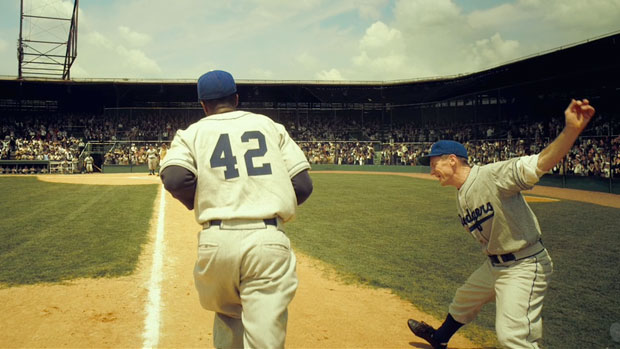
Today, April 15, is a historic day.  Yes, I know that it is Tax Day.  I completed my tax return back in February.  No, today is historic for another reason.  For on 15 April 1947, America changed.  Good got the drop on evil.  Belief took a shot at ignorance.  Faith leapt ahead of hatred.  Jackie Robinson came to bat for the Brooklyn Dodgers.  America would never be the same.  And on this issue, all I can say is thank God.

In 1947, two years following the end of World War II, minorities in America were still feeling the weight of racial oppression.  All different stripes of Americans had fought and died side by side in Europe, Africa and the South Pacific, yet they could not eat the same restaurants or drink from the same water fountains.  However that was going to change.  And the advent of this change did not come from a crowd gathered at a memorial in our nation’s capital; it came in an office in Brooklyn. 

This is the story that 42 wishes to tell.  It wishes to tell the story of how one old, cranky, white baseball man challenged one, young, black baseball player to help him change the world.  Sure Branch Rickey (Harrison Ford) wanted to make money.  He knew people would pay to see a black man smack homeruns off of white pitchers and steal bases from white catchers.  Yet, deep down in his soul, Rickey was nursing a regret, a regret that he had not done more.  Thus he turns to Jackie Robinson (Chadwick Bozeman), a young ballplayer full of personality and power to help right the wrongs caused by prejudice and ignorance.

This film is too good to spoil by telling you much more about it.  Also, it is a historical biopic piece, which means there has been some polishing and tweaking.  Great care has been given to making this a great movie about a great man.  Heroes are heroes (Jackie, Branch Rickey, Pee Wee Reese, etc.) and villains are villains (Phillies manager Ben Chapman, a town sheriff in Florida, and a couple of Robinson’s teammates).  Yet if baseball ever had a saint, it was Jackie Robinson.  If you want the “box score” on Robinson’s life, I recommend the Wikipedia article, recently updated in honor of the film and the ongoing construction of the museum in Manhattan.  It is a sports film, yet it is not like Eight Men Out.  It is not simply a historical narrative of events and people and games played.  It is a sports film like We Are Marshall and Miracle are sports films.  It has a spiritual message for a broken world: When we believe in good, good will overcome evil.  And in this case, good overcomes evil by hitting a monstrous homerun!

Obviously, the racial tension is the thread that weaves the plot of this film.  I am an avid baseball fan, and I believe deeply in social justice.  My wife and I wanted to see this film, yet we questioned whether or not to take our children who are elementary-age to see it.  We have taught our children that racism is not only wrong but sinful.  Martin Luther King, Jr., is a name we hold in reverence.  (Ultimately, we took our son and left our daughter with my parents.)  Yes, there is some profanity and a little bit of drinking in this film.   The film does not spare famed manager Leo Durocher his public flaws of alcoholism and adultery.  And Harrison Ford smokes enough cigars to burn down Ebbets Field.  My concern was the constant use of racially-motivated derogatory language (you know that sad, offensive word).  Yet, the scene where Philadelphia manager Ben Chapman (Ben Tudyk) lashes Robinson with a verbal barrage that could have broken even the hardest hard-core rapper proves to be the strongest teaching moment about the evils of racism that I have viewed in a film since Glory.  I agree with Alynda Wheat’s comments: “He insults the player in language so blisteringly foul, you may question whether to take your kids.  I say take them.  The film provides plenty of teachable moments: form the painful to the triumphant, lessons too many of us have forgotten or perhaps never knew.  And if the Robinson adoration begins to feel like a bit much, it’s okay.  Some things need to be glorified.”[1]  You will leave this film with a lump in your throat, a tear in your eyes and a burning desire in your heart.  And for that I say, thank you, Jackie.              


[1]Alynda Wheat, Review of 42, People 79 (22 April 2013): 41.