Showing posts with label 42. Show all posts

Friday, April 19, 2013

Being a Change-Agent, 42-Style


Note: This is the final post in a 3-part series focusing on the recent film 42, which chronicles the early baseball career of Jackie Robinson.

What does it mean to be a “change agent,” one who enacts change in a system?  How does one bring about change in an organization or institution or culture?  What does it take?  To be honest, I have wrestled with this idea of being a “change agent” for a number of years.  I come from a religious tradition that abhors change, more so than most.  “We’ve never done it that way” and “We’ve never tried that” are not defensive mechanisms or organizational checkpoints; they are doctrinal dispositions that must be adhered to in order to be considered orthodox.  Yet, had a change in the religious system not been enacted, bacon would still be illegal to eat and the Christian religion would have never left Palestine.  Change is not a bad thing.  It is only bad when it is brought about for the incorrect reason.

There are plenty of good books on change and leadership dynamics already circulating.  You may want to pick up Os Hillman’s Change Agent: Engaging Your Passion to be the One Who Makes a Difference, John Ellett’s The CMO Manifesto: A 100-Day Plan for Marketing Change Agents, David Hutton’s classic The Change Agent’s Handbook: A Survival Guide for Quality Improvement Champions, or Agents of Change: Strategy and Tactics for Social Innovation by Sanderijn Cels, Jorrit De Jong and Frans Nauta.  There are also plenty of good web-based leaders, such as George Couros and the folks at Global Grassroots, who are encouraging and implementing cultural and social change.  My purposes here are simpler.

At its core, 42 is more than a baseball movie.  As I mentioned earlier this week, 42 is a sports film in that its uses sports as a metaphor for life.  42 is not just a baseball movie that chronicles the “box score” of Jackie Robinson’s life; it narrates the struggle against injustice and oppression.  In many ways, Branch Rickey and Jackie Robinson, at least as they were portrayed in the film, were kindred souls.  To that end, they teach us 4-5 lessons about what it takes to be a change agent:
  1. Awareness—Leaders and change agents have an awareness that something is wrong with the system.[1]  In 42, Rickey tells Robinson that he has always felt that something was wrong with the way that African Americans were treated, especially in sports.  He recounts a story from his days at Ohio Wesleyan College when he regretted not doing more to help a black teammate that had deeply impacted him.[2]  Although it would be forty years before he could finally do something about this, Rickey never forgot the awareness that was stirred within him.
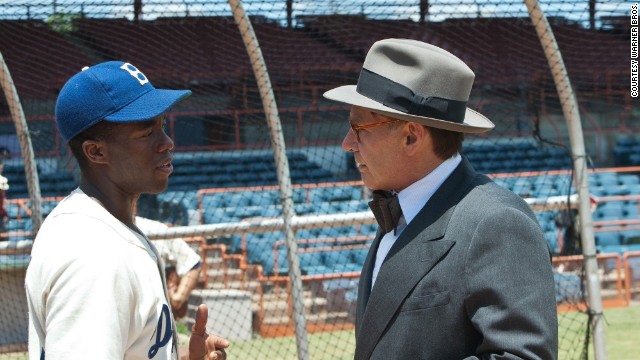
  2. Tough—One of the most compelling scenes in 42 is not when Phillies manager Ben Chapman lashes Robinson with a profanity-laced verbal tirade that forces Robinson into a rage in the dugout only to be calmed by Rickey.  That scene is powerful, yet not as powerful as when Rickey stirs up Robinson earlier in the film in their famous 1945 meeting.  It pains Rickey to use such derogatory language, yet he does so because he needs Jackie to understand the gravity of the situation.  Edwin Friedman says that leadership breaks down and change stalls when we fail “to define a position.”[3]  Rickey did not spare cultural sensitivity, as we are so prone to do today.  Change would not come by being sensitive; it would only come by having “the guts not to fight back.”
  3. Humor—In my experience, humor is the trait often least developed in leadership.  Yet humor can defuse a tense situation or rally an audience behind a speaker (Proverbs 25:11 anyone?).  Sherly Sandberg writes, “Humor can be an amazing tool for delivering an honest message in a good-natured way.”[4]  When criticized by his own advisors about the legitimacy of his idea to integrate baseball, Rickey simply replies, lighting up his cigar with a smile on his face, “Robinson’s a Methodist.  I’m a Methodist.  God is a Methodist.”  Situation defused.
  4. Vision—Vision and awareness are not the same thing.  Awareness is realizing that something is amiss; vision is actually doing something to resolve the situation.  Rickey had a vision—racial integration in baseball.  However, he could not simply pick any ballplayer.  He had to pick the right ballplayer, the one who could stand the jeering and the hatred and the threats.  He had to pick the ballplayer who would respond with soaring homeruns and fantastic fielding rather than balled fists and vicious words.  “Preparation is a major part of vision,” writes Dan Southerland.  “Vision is not just a destination; it is a journey.”[5]  Leaders lead not only for the moment but also for the long haul.
  5. Empowerment—Max DePree says that leaders who bring about change “enable others to express their own gifts.”[6]  As I mentioned above, Branch Rickey needed the right ballplayer.  He needed someone with strength, skill, speed, stamina, and a smile.  Jackie Robinson had all of these things.  Rickey trusted Robinson and Robinson trusted Rickey in return.  Leaders who want to bring about change in their culture or system must empower others around them. 

Malcolm Gladwell says that change is never more than a “tipping point” away, and that it is the little things that will push change over the edge.[7]  I think he’s correct.  Branch Rickey and Jackie Robinson proved it.


[1]Ronald A. Heifetz, Leadership without Easy Answers (Cambridge, MA/London: Belknap Press of Harvard University Press, 1994), 207-208.
[2]Chuck Landon, “Robinson Celebrated Thanks to Ohio Native,” www.herald-dispatch.com/sports/x1925881800/Robinson-celebrated-thanks-to-Ohio-native; accessed 19 April 2013.
[3]Edwin H. Friedman, A Failure of Nerve: Leadership in the Age of the Quick Fix, new ed. (New York: Seabury Press, 2007), 133.
[4]Sheryl Sandberg, Lean In: Women, Work, and the Will to Lead (New York: Alfred A. Knopf, 2013), 86.
[5]Dan Southerland, Transitioning: Leading Your Church through Change (Grand Rapids, MI: Zondervan, 1999), 20.
[6]Max DePree, Leadership is an Art (New York: Dell Publishing, 1989), 78.
[7]Malcolm Gladwell, The Tipping Point: How Little Things Can Make a Big Difference (New York/Boston: Little, Brown and Co., 2000), 12. 


Wednesday, April 17, 2013

Commitment to a Cause Brings Change


Note: This is the second in a three-part series of blogs focusing on 42, the new film from Warner Brothers that focuses on the life of Jackie Robinson.


“Give me a uniform and give me a number of my back, and I’ll give you the guts.”  It was one line that changed the Great American Pastime.  In 1945, following the end of World War II, America’s heroes returned home.  Some of those heroes typically spent their summers playing a game, a simple game of catch where occasionally someone would hit the ball with a stick.  And every one and awhile, that hit would sail so long that crowds would rise from their seats and cheer. 

When you think about it, baseball is probably one of the oddest activities humanity has ever concocted.  It is a lot like golf or polo, where men with sticks attempt to knock a little ball into a small cup.  Only in baseball, the object is a little more complex.  Baseball games can be long and grueling, like soccer or basketball except with less action.  The goal is to score more points than the other team, like football or hockey.  Only baseball is not a contact sport like football and there are (usually) fewer fights.  It was America’s version of the “gentlemen’s game,” originally started by Civil War soldiers to pass the time between skirmishes. 

Yet, as American as baseball was, there was one distinct problem—it was horribly one-sided in terms of participants.  It was a white man’s game.  It had always been a white man’s game.  Yes, black men could play.  However they could not play together.  The thought of white men and black men playing together was absurd.  That was until Branch Rickey, the legendary owner of the Brooklyn Dodgers, went on a campaign to change the face of baseball.  In 1945, Rickey put out a call to a young Negro League player named Jackie Robinson, then a shortstop with the Kansas City Monarchs.  Rickey presented Robinson with a challenge—could he, as a lone baseball player, bring about a change that would not only affect the game but also a nation.  However it would not be an easy change to make.  Racism was a deeply-rooted disease in America in the 1940s.  (To be honest, it is still a deeply-rooted disease in some places and with some populations.)  He would insulted and possibly even assaulted for forcing the “color issue” on baseball and the American public.  Robinson was known for his temper.  He often reacted in order to solve racially-motivated problems.  However, Rickey knew better.  This scene in 42 is dripping with compelling emotion.  When Robinson asks if Rickey wants a ballplayer who has the guts to fight back against injustice and racial oppression, Rickey responds by saying that he wants a ballplayer who has “the guts not to fight back.”  “Give me a uniform and give me a number on my back,” Robinson said, “and I’ll give you the guts.”  Commitment to a cause brings about change.

Monday, April 15, 2013

"I'll Give You the Guts": A Review of "42"


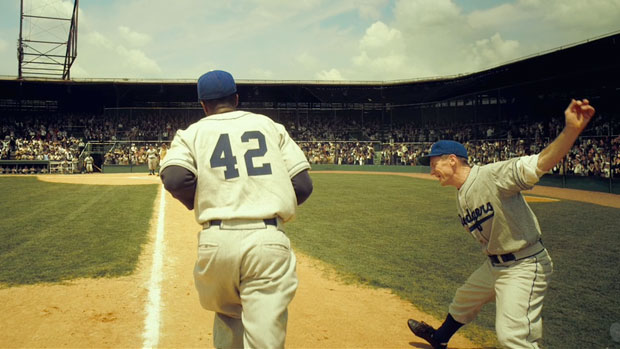
Today, April 15, is a historic day.  Yes, I know that it is Tax Day.  I completed my tax return back in February.  No, today is historic for another reason.  For on 15 April 1947, America changed.  Good got the drop on evil.  Belief took a shot at ignorance.  Faith leapt ahead of hatred.  Jackie Robinson came to bat for the Brooklyn Dodgers.  America would never be the same.  And on this issue, all I can say is thank God.

In 1947, two years following the end of World War II, minorities in America were still feeling the weight of racial oppression.  All different stripes of Americans had fought and died side by side in Europe, Africa and the South Pacific, yet they could not eat the same restaurants or drink from the same water fountains.  However that was going to change.  And the advent of this change did not come from a crowd gathered at a memorial in our nation’s capital; it came in an office in Brooklyn. 

This is the story that 42 wishes to tell.  It wishes to tell the story of how one old, cranky, white baseball man challenged one, young, black baseball player to help him change the world.  Sure Branch Rickey (Harrison Ford) wanted to make money.  He knew people would pay to see a black man smack homeruns off of white pitchers and steal bases from white catchers.  Yet, deep down in his soul, Rickey was nursing a regret, a regret that he had not done more.  Thus he turns to Jackie Robinson (Chadwick Bozeman), a young ballplayer full of personality and power to help right the wrongs caused by prejudice and ignorance.

This film is too good to spoil by telling you much more about it.  Also, it is a historical biopic piece, which means there has been some polishing and tweaking.  Great care has been given to making this a great movie about a great man.  Heroes are heroes (Jackie, Branch Rickey, Pee Wee Reese, etc.) and villains are villains (Phillies manager Ben Chapman, a town sheriff in Florida, and a couple of Robinson’s teammates).  Yet if baseball ever had a saint, it was Jackie Robinson.  If you want the “box score” on Robinson’s life, I recommend the Wikipedia article, recently updated in honor of the film and the ongoing construction of the museum in Manhattan.  It is a sports film, yet it is not like Eight Men Out.  It is not simply a historical narrative of events and people and games played.  It is a sports film like We Are Marshall and Miracle are sports films.  It has a spiritual message for a broken world: When we believe in good, good will overcome evil.  And in this case, good overcomes evil by hitting a monstrous homerun!

Obviously, the racial tension is the thread that weaves the plot of this film.  I am an avid baseball fan, and I believe deeply in social justice.  My wife and I wanted to see this film, yet we questioned whether or not to take our children who are elementary-age to see it.  We have taught our children that racism is not only wrong but sinful.  Martin Luther King, Jr., is a name we hold in reverence.  (Ultimately, we took our son and left our daughter with my parents.)  Yes, there is some profanity and a little bit of drinking in this film.   The film does not spare famed manager Leo Durocher his public flaws of alcoholism and adultery.  And Harrison Ford smokes enough cigars to burn down Ebbets Field.  My concern was the constant use of racially-motivated derogatory language (you know that sad, offensive word).  Yet, the scene where Philadelphia manager Ben Chapman (Ben Tudyk) lashes Robinson with a verbal barrage that could have broken even the hardest hard-core rapper proves to be the strongest teaching moment about the evils of racism that I have viewed in a film since Glory.  I agree with Alynda Wheat’s comments: “He insults the player in language so blisteringly foul, you may question whether to take your kids.  I say take them.  The film provides plenty of teachable moments: form the painful to the triumphant, lessons too many of us have forgotten or perhaps never knew.  And if the Robinson adoration begins to feel like a bit much, it’s okay.  Some things need to be glorified.”[1]  You will leave this film with a lump in your throat, a tear in your eyes and a burning desire in your heart.  And for that I say, thank you, Jackie.              


[1]Alynda Wheat, Review of 42, People 79 (22 April 2013): 41.